OEM vs ODM Activewear Manufacturing: Which Is Better for Your Brand?
Many buyers ask the wrong question first. They ask for the lowest unit price before deciding how much product control they actually need.
That can create problems later. The sample may look acceptable, but the fabric, fit, waistband, pocket, logo method, and packaging may not match the brand’s target market.
OEM activewear manufacturing is better when a brand needs deeper control over fabric, fit, function, sizing, and brand identity. ODM activewear manufacturing is better when a brand needs faster market testing with fewer design decisions. The right choice depends on brand stage, MOQ, sample lead time, customization depth, launch timeline, and repeat-order risk.
In our factory communication, this topic comes up often with activewear brands, Amazon sellers, Shopify sellers, importers, and sourcing managers.
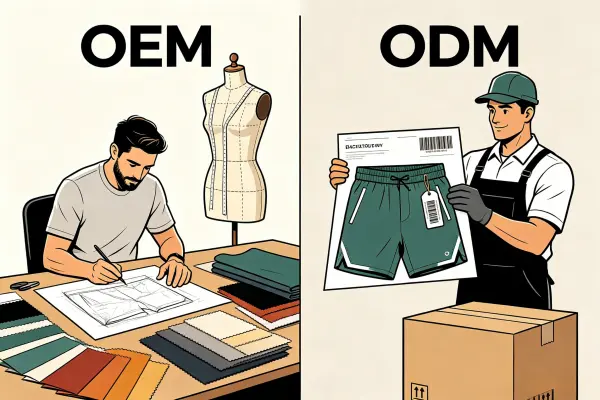
Many people think OEM only means “add my logo,” and ODM only means “use the factory design.” That explanation is too simple for real sportswear production.
A pair of gym shorts is not only fabric and a logo. It may include waistband structure, drawcord, pocket shape, inner lining, stitching method, size grading, labels, hangtags, barcode stickers, and packaging. Each part affects comfort, cost, brand feeling, and repeat production.
That is why OEM vs ODM should be treated as a business decision, not only a production term.
What Do OEM and ODM Really Mean in Activewear Manufacturing?
Many buyers use OEM and ODM too loosely. This can create wrong expectations, unclear quotes, and samples that do not match the real product plan.
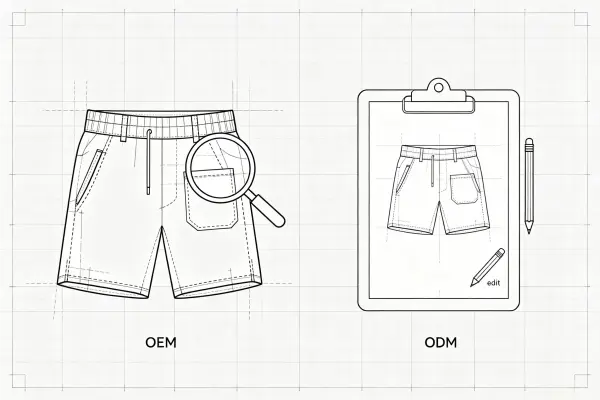
In activewear manufacturing, OEM means the factory produces according to the buyer’s design direction, product specifications, and brand requirements. ODM means the factory provides an existing or factory-developed design that the buyer can use, adjust, and brand within certain limits.
Focus on Control, Not Only the Definition
Real OEM production is not simple logo printing.
For custom gym shorts or running shorts, OEM can include choices such as:
- polyester-spandex or nylon-spandex fabric
- woven stretch or knit stretch construction
- 5-inch, 7-inch, or custom inseam
- regular fit or athletic fit
- built-in compression liner
- side pocket, zipper pocket, or phone pocket
- soft elastic waistband or structured waistband
- flatlock seams or standard seams
- heat transfer logo, embroidery, silicone print, or woven patch
- custom neck label, wash label, hangtag, and packaging
Each choice affects the sample, unit cost, production time, and final customer experience.
ODM is different. The factory may already have a basic running short, gym short, training short, or 2-in-1 short pattern. The buyer can select colors, add a logo, adjust minor trims, and start faster. This can work well when the buyer needs speed or wants to test a new product category.
But ODM usually gives less control over fit, pattern, fabric structure, and product differentiation.
| Item | OEM Activewear | ODM Activewear |
|---|---|---|
| Product base | Buyer-driven design | Factory-developed design |
| Customization depth | High | Low to medium |
| Sampling work | More detailed | Faster at the beginning |
| Brand difference | Stronger | More limited |
| Best use | Long-term product line | Market test or fast launch |
| Main risk | More development decisions | Less product uniqueness |
Before choosing OEM or ODM, ask one practical question:
Do you want to build your own product, or do you want to launch quickly with a proven base?
This question usually gives a clearer answer than the label itself.
When Should You Choose OEM for Custom Gym Shorts or Running Shorts?
Choose OEM when the product needs strong brand control, better fit, deeper customization, and repeatable quality.
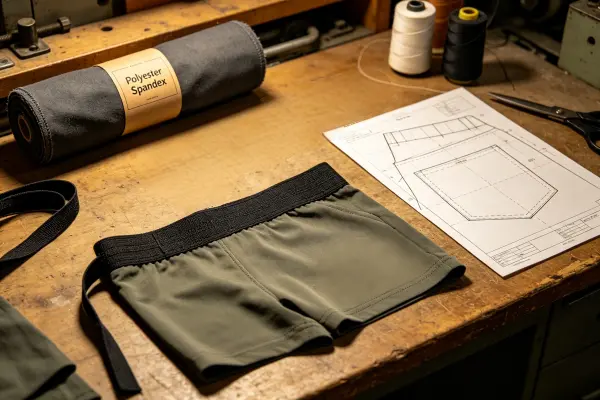
Use OEM When the Product Is Part of Your Brand Identity
During product development, many growing brands start with a simple goal: launch a gym short or running short quickly. Later, they begin to care more about details.
They start asking:
- How should the waistband feel?
- How deep should the pockets be?
- Should the short use a liner?
- Should the fabric feel lightweight or structured?
- Should the logo be printed, embroidered, or heat transferred?
- Can the same fit be repeated in the next order?
This is where OEM becomes more useful.
OEM is not only for large brands. Smaller brands can also use OEM if they have a clear product direction and a realistic MOQ. At EWO, our usual MOQ is 300 pcs, which can support many custom shorts projects when the product plan is clear.
| OEM Decision Point | Why It Matters |
|---|---|
| Fabric choice | Affects stretch, weight, drying speed, hand feel, and price |
| Pattern and fit | Affects comfort, movement, and customer reviews |
| Waistband design | Affects support, comfort, and daily wear feeling |
| Pocket structure | Affects function and product value |
| Lining choice | Affects gym, running, and training use |
| Label and packaging | Affects retail, DTC, and private label presentation |
Based on our OEM experience, OEM is also stronger for repeat orders. When the fabric, pattern, trims, logo method, and packaging are documented clearly, the next production can stay closer to the approved sample.
This does not remove every production risk, but it creates a clearer standard for both buyer and factory.
OEM is usually the better choice when your brand wants to build a product that customers can recognize and buy again.
When Should You Choose ODM for Activewear Market Testing?
Choose ODM when your brand needs faster market testing, lower design workload, and a practical way to launch without building every detail from zero.
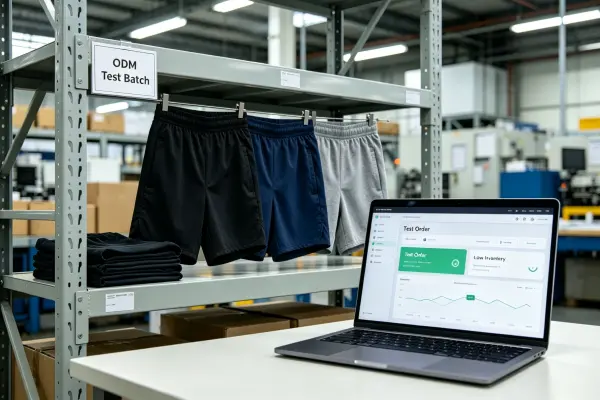
Use ODM When Speed Matters More Than Deep Control
ODM can be useful when a buyer wants to test a product category before investing in a full custom line.
For example:
- A Shopify seller wants to test running shorts in three colors.
- An Amazon seller wants to check demand for 2-in-1 training shorts.
- An importer needs a practical style for a seasonal program.
- A startup brand wants to launch quickly with limited design resources.
In these cases, a factory-developed ODM base can reduce early development work.
But ODM is not automatically safer or cheaper. It can be faster at the beginning, but it may create limits later.
The buyer may not be able to change the waistband shape too much. The base pattern may not fit the target customer. A new fabric may still require a fabric MOQ. The final product may also look similar to other market styles.
| ODM Advantage | Possible Limit |
|---|---|
| Faster sample start | Less control over fit |
| Less design work | Weaker product difference |
| Easier first discussion | Limited fabric changes |
| Useful for testing | Harder to build a unique product line |
| Lower early effort | Repeat consistency still needs checking |
During sample discussions, I suggest buyers separate all requested changes into two groups:
- Must change
- Nice to change
This keeps the ODM process realistic. If too many parts are “must change,” the project may no longer be ODM. OEM or semi-custom manufacturing may be a better route.
What Hidden Costs Should You Compare Before Deciding?
A low quote can look attractive at first. But extra sampling rounds, fabric changes, trim changes, and delayed approval can make the real cost much higher.
The better approach is to compare total cost and total sourcing risk, not only unit price.
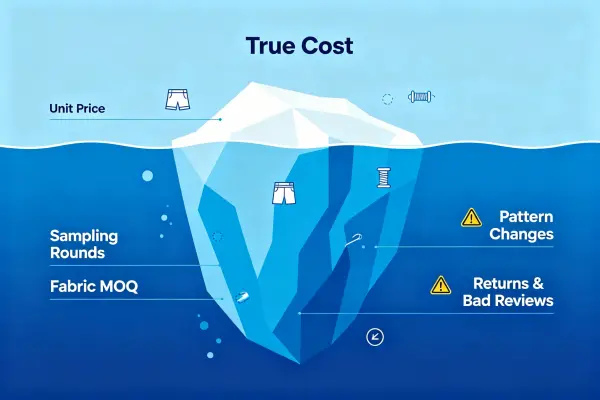
Check the Cost Behind the Unit Price
One issue we frequently encounter is that buyers compare OEM and ODM only by first quote.
That is risky.
A cheap short can become expensive if:
- the fabric pills after washing
- the waistband twists during wear
- the liner feels uncomfortable
- the size grading is poor
- the bulk color does not match the approved sample
- the logo cracks or peels
- the pocket position does not work for real use
- the product receives returns or bad reviews
Sampling also has a real cost. OEM usually needs more detail in the first sample. The buyer may adjust inseam length, pocket position, waistband tension, lining fabric, logo size, or packaging. Each change takes time.
ODM may need fewer changes at first, but it can still require revision if the base design does not fit the brand’s customer.
| Cost Factor | OEM Impact | ODM Impact |
|---|---|---|
| Sampling rounds | Often higher | Often lower at first |
| Fabric MOQ | Depends on chosen fabric | Depends on base fabric availability |
| Pattern changes | More possible | More limited |
| Lead time | Longer during development | Faster if base style is ready |
| Differentiation | Stronger | Lower |
| Repeat-order control | Better when specs are fixed | Depends on factory system |
Clear documentation helps reduce hidden costs. A simple tech pack, reference sample, size chart, fabric target, logo file, and packaging note are better than vague messages.
At EWO, sample development usually takes 7–10 days when product details are clear. Bulk production usually takes 20–30 days, depending on fabric, trims, logo process, packaging, order quantity, and production schedule.
How Does Brand Stage Affect the OEM vs ODM Choice?
A new brand can burn cash by over-customizing too early. A growing brand can lose its edge by staying with generic products too long.
The right route depends on brand stage, product confidence, budget, MOQ tolerance, and repeat-order needs.
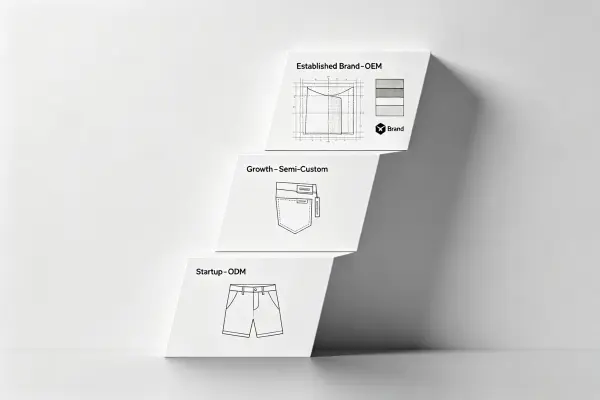
Match the Production Route to Your Business Stage
There is no single rule for every buyer.
A first-time Amazon seller does not have the same needs as a DTC brand with repeat customers. An importer running a seasonal program does not make decisions the same way as a founder building a long-term product line.
That is why OEM is not always better, and ODM is not always low-end.
A new seller may need a simple product test. This seller may not yet know the best inseam, fabric weight, waistband type, color direction, or pocket demand. A semi-custom ODM route may be enough.
A growing brand may already understand its customer. This brand may need better fabric, stronger waistband recovery, special pocket placement, custom fit, and consistent sizing. OEM may be the better fit.
| Brand Stage | Better Starting Point | Main Reason |
|---|---|---|
| First product test | ODM or semi-custom | Lower development load |
| Early sales stage | Semi-custom OEM | Better brand control with less risk |
| Growing DTC brand | OEM | Stronger product identity |
| Importer program | Depends on buyer specs | Balance speed and price |
| Established activewear brand | OEM | Long-term consistency and differentiation |
Cash flow should also be considered. A buyer with a limited first-order budget should not customize too many fabrics, trims, labels, and packaging details at the same time.
For many early-stage brands, the smarter path is to focus on the details customers can feel:
- fabric hand feel
- waistband comfort
- fit and inseam
- pocket function
- logo durability
- basic packaging quality
These details often matter more than adding too many decorative trims in the first order.
If you need help deciding which product category to start with, you can review EWO’s custom shorts product range to compare gym shorts, running shorts, training shorts, board shorts, and other custom shorts options.
What Should You Ask a Factory Before Choosing OEM or ODM?
A supplier mismatch can cost more than a higher unit price. Poor communication, weak samples, and unclear standards can damage the full launch.
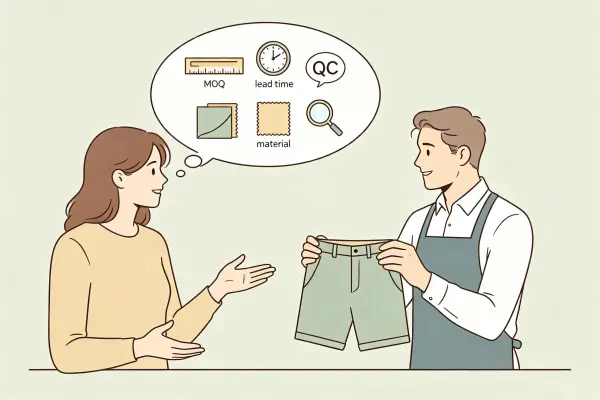
Before choosing OEM or ODM, ask the factory about customization scope, MOQ, sample lead time, fabric options, pattern ability, bulk QC, export experience, and repeat-order control.
Ask Questions That Reveal the Real Process
A serious buyer should not only ask, “What is your price?”
A better buyer asks how the product will be developed, what can be customized, what cannot be changed, and how the factory will keep bulk production close to the approved sample.
For custom athletic shorts, the factory should be able to discuss:
- fabric
- fit
- pattern
- waistband
- lining
- pockets
- stitching
- labels
- packaging
- sample approval
- bulk quality control
If the factory only talks about logo printing, the buyer may not get real OEM support.
| Question to Ask | What You Learn |
|---|---|
| What parts can I customize? | The real OEM depth |
| What is the sample lead time? | Whether the launch timeline is realistic |
| What is the MOQ by style and fabric? | Inventory and fabric risk |
| Can I adjust the pattern? | Fit control ability |
| Can I choose fabric weight and stretch? | Product function control |
| How do you handle bulk QC? | Repeat quality stability |
| Have you shipped to US or EU buyers? | Export communication and compliance experience |
Factory focus also matters.
A general garment factory may make many categories. A shorts-focused factory may understand shorts details better. This can matter for athletic shorts, gym shorts, running shorts, board shorts, training shorts, and 2-in-1 shorts.
For B2B buyers, the best supplier is not always the one with the biggest catalog. It is often the one that can explain real product decisions clearly.
For brands that need deeper development support, EWO’s OEM / ODM manufacturing service can help organize product direction, sample development, customization details, and bulk production standards.
How Can You Make a Practical OEM vs ODM Decision?
Too many options can slow the project. A buyer may compare samples for weeks and still not know which route reduces risk.
A practical decision should be based on product goal, required customization, budget range, MOQ tolerance, launch deadline, and repeat-order needs.
Use a Simple Decision Map
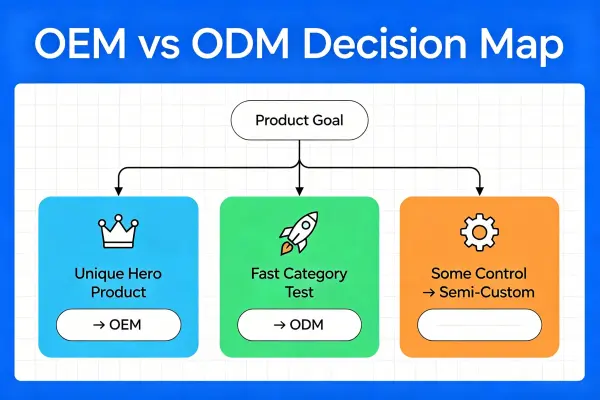
Start with the product goal.
If the buyer wants a unique hero product, OEM is usually better. If the buyer wants to test a category quickly, ODM may be more practical. If the buyer wants some brand control but does not need a full custom build, semi-custom manufacturing can be a useful middle route.
Semi-custom can work well for many growing brands. The buyer may use an existing pattern but change fabric, pocket, logo, drawcord, labels, and packaging. This gives more control than basic ODM without requiring every detail to be developed from zero.
| If Your Priority Is... | Consider This Route |
|---|---|
| Fast launch | ODM |
| Strong brand identity | OEM |
| Lower early design work | ODM |
| Better fit and function control | OEM |
| Moderate customization | Semi-custom |
| Long-term repeat product | OEM |
| Small market test | ODM or semi-custom |
Before bulk production, set approval standards early. This may include:
- fabric hand feel
- fabric weight or structure
- stretch and recovery
- color standard
- size chart
- logo size and position
- waistband tension
- pocket depth
- stitching quality
- label position
- packaging method
Clear standards reduce confusion later. They also help the factory understand what the brand really cares about.
Common Mistakes When Choosing OEM or ODM Activewear Manufacturing
Many problems happen because the buyer chooses the production route before defining the product goal.
Mistake 1: Thinking OEM Only Means Logo Printing
Logo printing is only one part of customization. Real OEM can include fabric, pattern, fit, waistband, pockets, liner, stitching, labels, and packaging.
Mistake 2: Using ODM but Expecting Full Custom Control
ODM is useful for speed, but it usually has limits. If the buyer wants to change too many parts, OEM or semi-custom may be a better route.
Mistake 3: Choosing the Lowest Quote Without Checking Specifications
A low quote may use different fabric, simpler trims, weaker packaging, or fewer custom details. Always compare what is included.
Mistake 4: Over-Customizing Before Testing Demand
A new brand may not need custom fabric, custom trims, complex packaging, and many colorways in the first order. Start with details that customers can feel.
Mistake 5: Ignoring Repeat-Order Stability
A successful first order is not enough. Ask whether the same fabric, color, trims, pattern, and packaging can be repeated in future production.
Checklist: OEM or ODM Activewear Manufacturing?
Use this checklist before choosing your production route.
Choose OEM if:
- You need strong product differentiation
- You have a clear product direction
- You want better control over fit and fabric
- You need custom waistband, pockets, or liner
- You care about long-term repeat production
- You are building a branded product line
Choose ODM if:
- You need faster market testing
- You do not have a complete design yet
- You want to reduce early development workload
- You accept limited fit and pattern changes
- You need a practical starting point
- You are testing a new product category
Choose semi-custom if:
- You want a balance between speed and brand control
- You can use an existing pattern but change key details
- You want to control fabric, logo, labels, or packaging
- You are not ready for full OEM development
- You need a safer first step before a full custom line
FAQ: OEM vs ODM Activewear Manufacturing
What is OEM activewear manufacturing?
OEM activewear manufacturing means the factory produces sportswear according to the buyer’s design direction, product specifications, fabric needs, size chart, logo method, and brand requirements.
What is ODM activewear manufacturing?
ODM activewear manufacturing means the factory provides an existing or factory-developed design that the buyer can use, adjust, and brand within certain limits.
Is OEM better than ODM for gym shorts?
OEM is better when the brand needs strong control over fit, fabric, waistband, pockets, liner, logo, and repeat production. ODM may be better for faster product testing.
Is ODM cheaper than OEM?
ODM can reduce early development work, but it is not always cheaper overall. The final cost still depends on fabric, MOQ, trims, logo method, packaging, revisions, and repeat-order stability.
What MOQ is common for OEM or ODM activewear?
At EWO, the usual MOQ is 300 pcs. MOQ may vary depending on fabric, color, trims, logo process, and customization depth.
How long does activewear sampling and bulk production take?
Sample development usually takes 7–10 days. Bulk production usually takes 20–30 days, depending on fabric, trims, logo method, packaging, order quantity, and production schedule.
Conclusion
OEM, ODM, and semi-custom manufacturing all have value. The best choice depends on brand stage, product control, MOQ, sample lead time, launch deadline, and repeat-order risk.
For a fast market test, ODM or semi-custom may be enough. For a branded product line with stronger fit, fabric, function, and long-term consistency, OEM is usually the better choice.
The right decision is not only about price. It is about matching the production route to the customer, the product promise, and the brand’s growth plan.
If your brand is developing custom gym shorts, running shorts, training shorts, or other activewear products, you can contact EWO to discuss your OEM / ODM project, send your tech pack, or request a sample.