Activewear Fabric Test Report: Nylon-Spandex vs Polyester-Spandex
Two fabrics can contain almost the same percentage of spandex and still behave very differently once they are turned into activewear.
A nylon-spandex fabric may feel smoother and more premium in hand. A polyester-spandex fabric may offer better cost control, faster sourcing, or a more suitable surface for a particular training short.
For a clothing brand, the question is therefore not simply:
“Is nylon better than polyester?”
The better question is:
Which fabric performs better for the product we are actually developing?
Nylon-Spandex vs Polyester-Spandex is mainly a comparison of hand feel, abrasion resistance, moisture behavior, stretch, drying performance, color, cost, and intended use. Nylon-spandex is often selected when buyers prioritize softness, stretch, and a premium hand feel, while polyester-spandex is commonly used when brands need good durability, moisture management, broader fabric availability, and more controlled production costs.
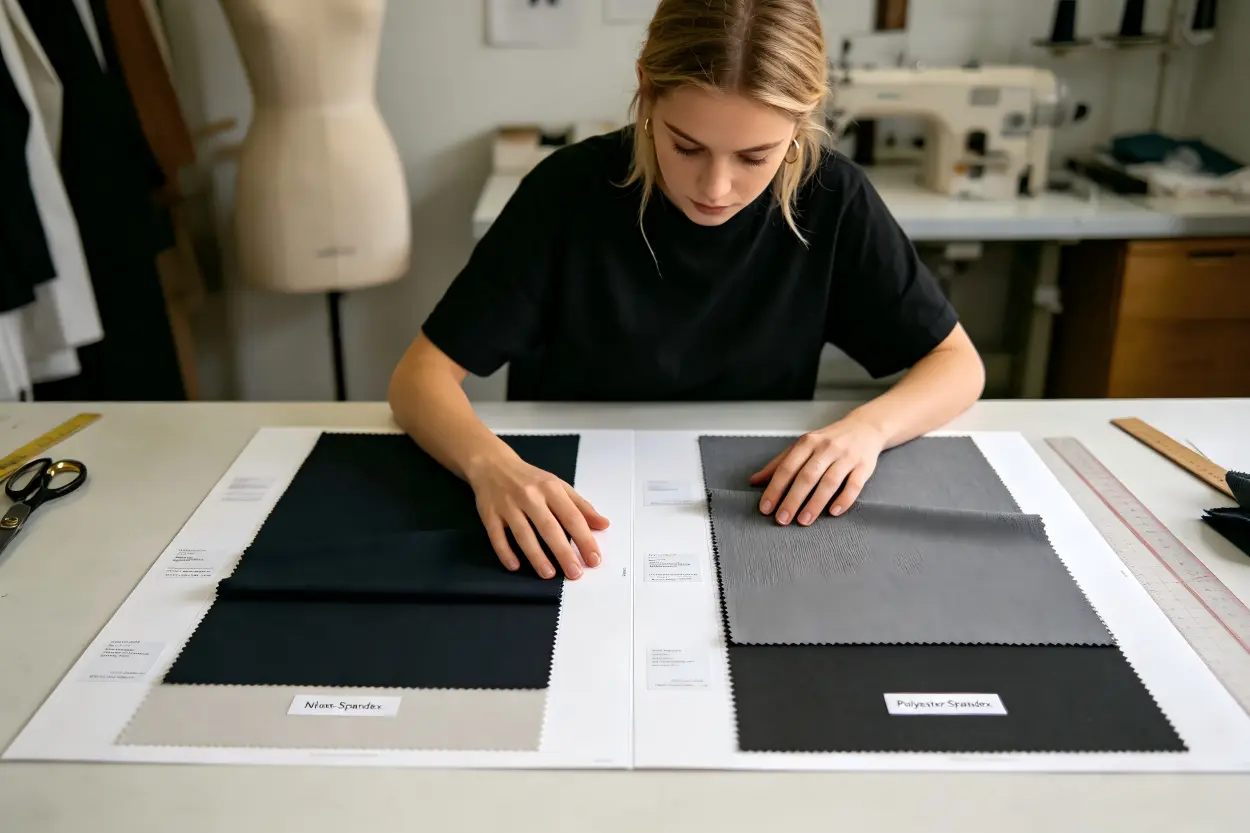
In our activewear development work, we do not select a fabric only from the fiber name.
For brands developing gym shorts, running shorts, 2-in-1 training shorts, or performance T-shirts, OEM manufacturing allows the buyer to control fabric composition, GSM, stretch, hand feel, surface structure, color, and performance direction before sampling begins.
Nylon-Spandex vs Polyester-Spandex: What Is the Main Difference?
Both fabrics combine a main synthetic fiber with spandex to create stretch.
The difference is the base fiber.
Nylon-spandex combines nylon with elastane or spandex.
Polyester-spandex combines polyester with elastane or spandex.
That may sound like a small difference on a specification sheet, but the final garment can feel very different.
| Comparison Point | Nylon-Spandex | Polyester-Spandex |
|---|---|---|
| Hand feel | Often smoother and softer | Varies from smooth to structured |
| Stretch feel | Often very comfortable and flexible | Can provide strong stretch and recovery |
| Abrasion resistance | Often strong | Generally good |
| Moisture absorption | Nylon absorbs more moisture | Polyester absorbs less moisture |
| Drying direction | Can retain more moisture | Often preferred for quick-dry applications |
| Surface appearance | Frequently more premium/matte | Very wide range of finishes |
| Color options | Good | Very broad |
| Cost | Often higher | Often more economical |
| Fabric availability | Depends on construction | Usually very broad |
These are general production tendencies rather than guaranteed performance values.
The actual result depends on yarn, knitting or weaving structure, GSM, finishing, spandex percentage, dyeing, and fabric supplier.
What Should an Activewear Fabric Test Actually Check?
A buyer should not approve fabric based only on composition.
For example:
88% polyester / 12% spandex
does not tell you whether the material is lightweight, stiff, soft, breathable, shiny, brushed, densely woven, or suitable for running.
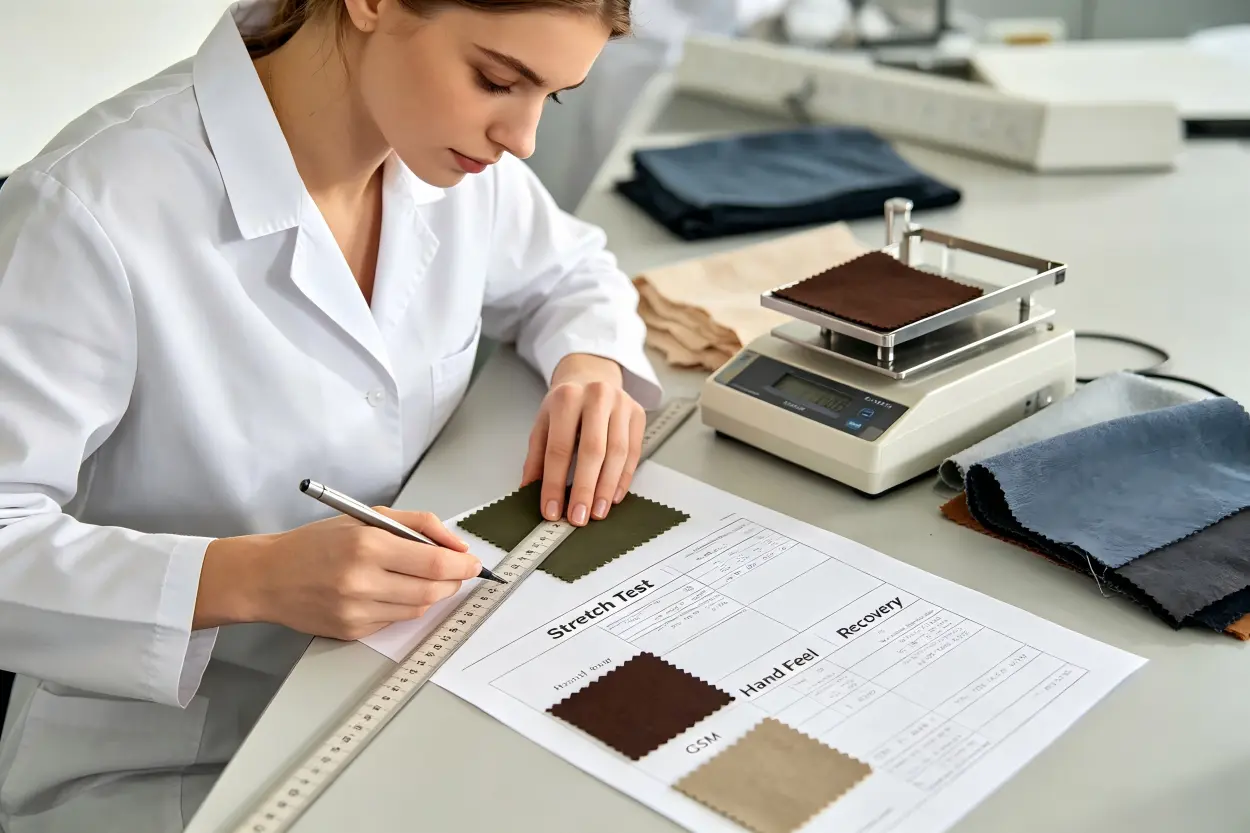
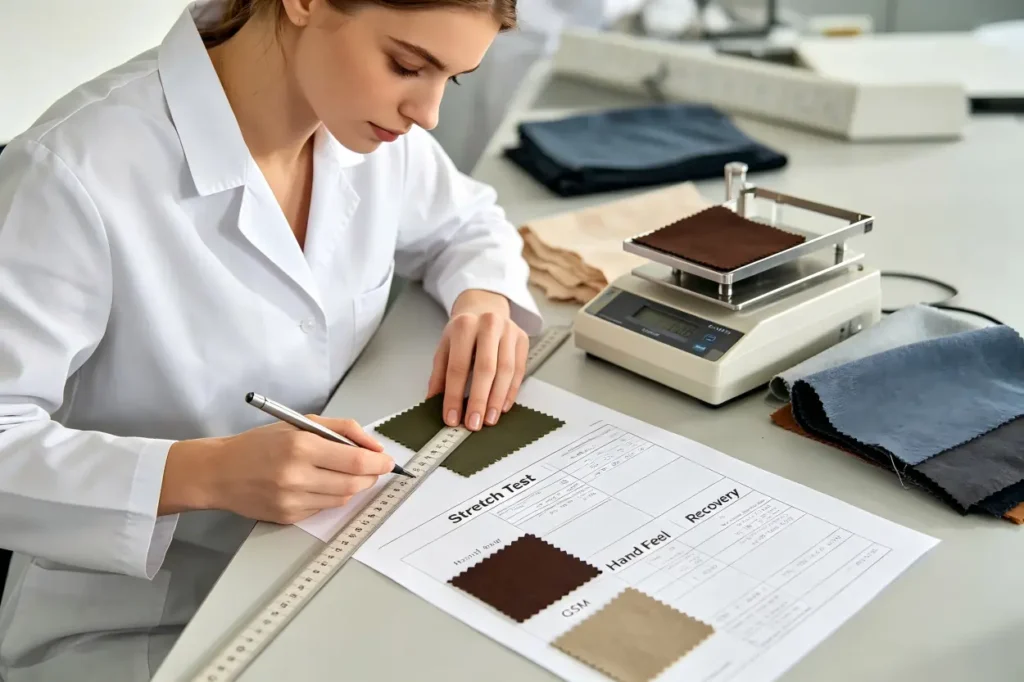
During product development, we normally look at the fabric from several practical angles.
1. Fabric Weight and GSM
GSM strongly affects the character of the finished garment.
A lighter material may work well for running.
A slightly heavier fabric may provide more structure for gym shorts or training apparel.
The correct GSM depends on the product rather than the fiber name alone.
2. Stretch and Recovery
Spandex percentage matters, but it is not the complete answer.
Two fabrics containing 10% spandex can stretch differently because of:
- Yarn structure
- Knit or weave
- Fabric density
- Finishing
- Stretch direction
For gym and training products, recovery is also important.
A fabric that stretches easily but does not return to shape can create problems around the waistband, seat, knees, or body fit.
3. Hand Feel
This is one area where technical specifications often fail to describe what the buyer actually wants.
A buyer may ask:
“Can you use 90% nylon and 10% spandex?”
But the real requirement may be:
“We want a smooth, soft, premium fabric similar to the feel of high-end training wear.”
Those are different instructions.
Based on our OEM experience, defining the target hand feel can be just as important as defining the fiber composition.
4. Moisture and Drying Behavior
Polyester generally absorbs less moisture than nylon, which is one reason it is widely used in performance garments.
But “polyester” alone does not guarantee excellent moisture-wicking or quick-dry performance.
Fabric structure and finishing matter.
If a buyer needs documented moisture-management performance, the correct approach is to check the material supplier's technical information or conduct the required third-party test.
We avoid treating marketing terms such as quick-dry or moisture-wicking as laboratory results unless they are supported by actual documentation.
Which Fabric Is Better for Gym Shorts?
Gym shorts have to handle repeated movement, stretching, washing, and contact with training equipment.
For custom gym and running shorts, buyers often need to balance:
- Stretch
- Durability
- Hand feel
- Weight
- Cost
- Pocket construction
- Appearance
Nylon-Spandex for Gym Shorts
Nylon-spandex can be a good direction when the brand wants:
- Smooth premium hand feel
- Comfortable stretch
- A refined surface
- Higher-end product positioning
It can work particularly well for premium training shorts where fabric feel is an important part of the customer's perception of quality.
Polyester-Spandex for Gym Shorts
Polyester-spandex is also widely suitable for gym products.
It may be more practical when the buyer prioritizes:
- Quick drying
- Broad fabric availability
- Stable sourcing
- Cost control
- Different surface structures
There is no automatic winner.
The decision should be based on the desired product positioning.
Which Fabric Is Better for Running Shorts?
Running shorts create a slightly different set of priorities.
Weight, drying speed, airflow, and low restriction become more important.
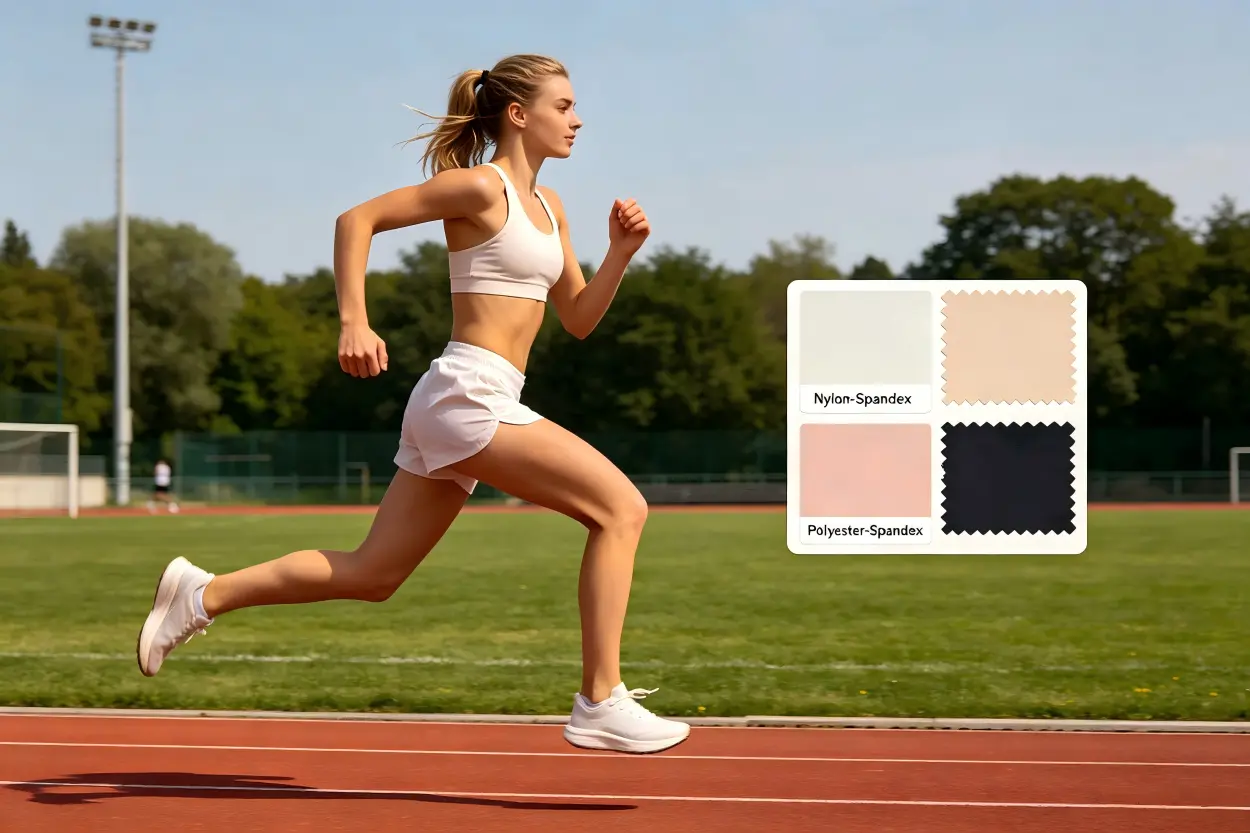
For running shorts, polyester-spandex is often a practical starting point because polyester has low moisture absorption and is available in many lightweight woven constructions.
However, a lightweight nylon-spandex woven fabric may also produce an excellent running short, especially when the buyer wants a softer or more premium feel.
The better question is:
What does the runner need from this specific short?
For example:
- Is it a lightweight race short?
- A 5-inch running short?
- A 2-in-1 style?
- A gym-and-running crossover product?
- Does it need zip pockets?
- Does it need a compression liner?
Those decisions affect fabric choice.
What About 2-in-1 Training Shorts?
A 2-in-1 short is a good example of why one garment may require two completely different fabrics.
The outer shell and compression liner perform different jobs.
For the outer layer, the buyer may select:
- Polyester-spandex woven
- Nylon-spandex woven
- Lightweight mechanical-stretch polyester
For the liner, the requirements may shift toward:
- Higher elasticity
- Recovery
- Softness
- Reduced friction
- Body support
During sample development, we therefore evaluate the outer short and liner separately rather than trying to use one fabric specification for both.
The finished garment needs the two materials to work together.
Nylon-Spandex vs Polyester-Spandex for Performance T-Shirts
The same comparison also applies to custom performance T-shirts.
Polyester-based fabrics are extremely common in performance T-shirts because they can provide:
- Lightweight constructions
- Quick-dry direction
- Different mesh structures
- Good print compatibility
- Broad color availability
Nylon-spandex may make more sense for products where the buyer wants:
- A smoother touch
- More elastic feel
- Premium positioning
- Slim or close-to-body fit
For example, a compression-style training shirt and a lightweight running event T-shirt should not automatically use the same material.
The activity comes first.
Fabric selection comes second.
Buyer Pain Point: “The Composition Is Correct, but the Fabric Feels Wrong”
This is one of the most useful lessons in activewear sourcing.
A buyer approves:
88% polyester / 12% spandex
Then the sample arrives.
The composition is correct, but the material feels too stiff, too shiny, too heavy, or too thin.
Technically, the factory followed the fiber specification.
Commercially, the product still missed the target.
That is why a more complete fabric request should include:
- Composition
- GSM
- Stretch direction
- Surface
- Hand feel
- Intended activity
- Target product positioning
A physical reference swatch can make the requirement even clearer.
Common Fabric Selection Mistakes
Choosing Only by Fiber Composition
“90% nylon / 10% spandex” is not enough to define a fabric.
Assuming More Spandex Is Always Better
Higher spandex content does not automatically mean better activewear.
Too much elasticity can change structure, cost, hand feel, and fit.
Using One Fabric Across an Entire Collection
Gym shorts, running shorts, compression liners, and T-shirts perform different jobs.
A single fabric specification rarely solves every product requirement.
Approving Fabric Only From Photos
Photos can show color and surface appearance.
They cannot communicate hand feel, stretch, recovery, thickness, or movement.
A physical sample is much more useful before bulk production.
Practical Fabric Decision Framework
When deciding between nylon-spandex and polyester-spandex, buyers can use five questions.
1. What Activity Is the Product Designed For?
Running, lifting, training, boxing, and daily activewear create different performance priorities.
2. What Hand Feel Does the Brand Want?
Premium soft touch and lightweight technical feel are not the same product direction.
3. How Important Is Drying Performance?
For products exposed to heavy sweating, moisture behavior may become a bigger priority.
4. What Is the Target Price Position?
Material choice must work with the final retail positioning and production budget.
5. Will the Fabric Be Repeatable?
For repeat production, sourcing consistency matters.
A beautiful fabric that becomes impossible to reorder can create another problem later.
Activewear Fabric Approval Checklist
Before approving a bulk fabric, check:
- Fabric composition
- GSM
- Width
- Stretch direction
- Stretch recovery
- Hand feel
- Surface appearance
- Color
- Opacity
- Intended activity
- Logo compatibility
- Wash expectations
- Supplier documentation where required
- Repeat-order availability
For custom projects, these decisions should ideally be made before or during sampling rather than after bulk fabric has been ordered.
Our production process explains how fabric confirmation, sample development, approval, and bulk manufacturing connect.
Frequently Asked Questions
Is nylon-spandex better than polyester-spandex for activewear?
Neither is automatically better. Nylon-spandex is often selected for softness, stretch, and premium hand feel, while polyester-spandex is widely used for quick-dry applications, broad fabric availability, and cost control. The correct choice depends on the garment.
Is nylon-spandex better for gym shorts?
It can be a good option for premium gym shorts requiring a smooth surface and comfortable stretch. Polyester-spandex can be equally suitable when drying performance, fabric structure, availability, or cost is more important.
Is polyester-spandex better for running?
Polyester-spandex is commonly used for running because polyester absorbs relatively little moisture and is available in many lightweight constructions. However, actual performance still depends on fabric structure and finishing.
Should I choose fabric based on spandex percentage?
No. Spandex percentage is only one variable. GSM, construction, stretch direction, recovery, surface, yarn, and finishing can all change how the fabric performs.
Conclusion
The Nylon-Spandex vs Polyester-Spandex decision should not be made from fiber composition alone.
For activewear buyers, the real comparison is between the performance of two complete fabric constructions.
Nylon-spandex may be the better direction when softness, stretch, and premium hand feel are priorities.
Polyester-spandex may be more suitable when the product requires quick-dry direction, broad material options, stable sourcing, and controlled costs.
For brands developing gym shorts, running shorts, 2-in-1 training shorts, or performance T-shirts, the safest approach is to define the activity, target feel, GSM, stretch, construction, and performance requirements before approving the material.
If you have a fabric swatch, reference garment, tech pack, or activewear concept, you can contact us to discuss the fabric direction and request a development sample.