
Runners hate chafing, bouncing pockets, and exposed coverage. I see these small problems turn a good run into an annoying one very fast.
Runners wear compression tights under shorts to improve comfort, reduce thigh rubbing, add coverage, and keep the inner layer stable during movement. From a product view, this habit also explains why brands develop 2-in-1 running shorts with built-in compression liners.
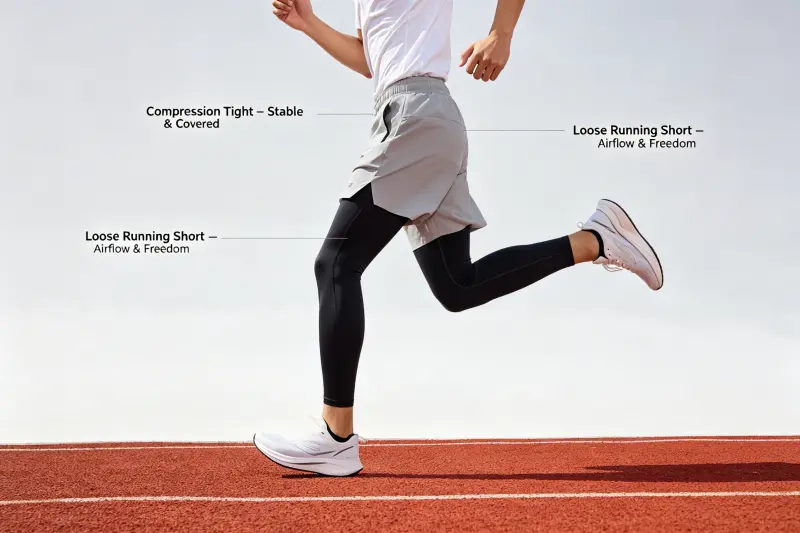
I work with custom running shorts and 2-in-1 shorts, so I do not look at this topic only as a runner style choice. I look at it as a product structure problem. When brands ask me why runners layer tights under shorts, I usually see four practical reasons. The runner wants less friction. The runner wants more coverage. The runner wants a stable inner layer. The runner may also want pockets that sit close to the body. This is why the real question is not only “why do runners do it?” The better question is “how should a sportswear brand design the right short for that use case?”
Do Runners Wear Compression Tights Under Shorts To Reduce Chafing?
Thigh rubbing can ruin a run. I see many brands ignore this problem until customer feedback makes it very clear.
Runners often wear compression tights under shorts because the tight inner layer can reduce skin-to-skin rubbing on the thighs. The smooth fabric gives more coverage than a loose short alone. This can help runners feel more comfortable during longer runs or repeated training.
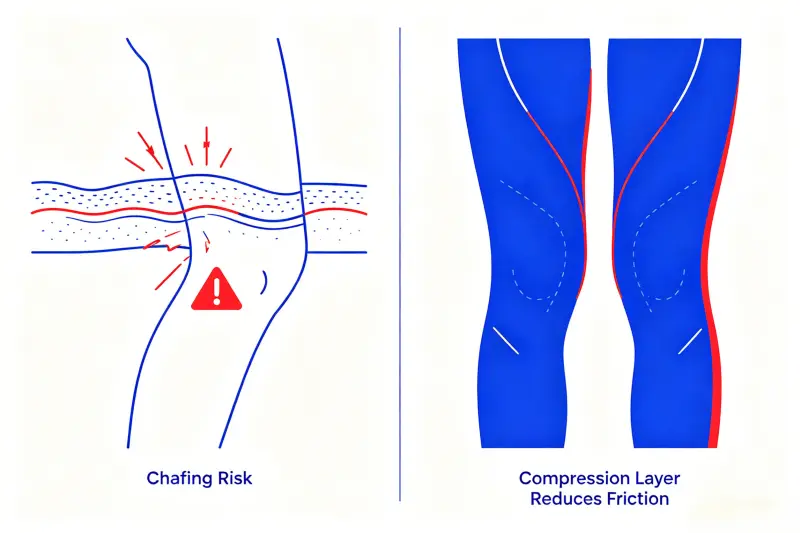
In custom running shorts development, I treat chafing as a construction issue first. The outer short may look light and fast, but it does not always protect the inner thigh. If the inseam is very short, the leg opening moves a lot. If the fabric is stiff, the edge can rub. If the liner is only a brief or mesh liner, it may not cover the high-friction area. This is where a compression tight or compression liner changes the feel.
| Design area | What I check | Why it matters |
|---|---|---|
| Inner length | 5 inch, 7 inch, or longer | It changes thigh coverage |
| Fabric face | Smooth or rough | It changes friction feel |
| Seam position | Inner thigh or shifted seam | It changes rubbing risk |
| Leg opening | Loose or grippy | It changes liner movement |
I do not claim that compression tights prevent injury or make every runner faster. I focus on the direct garment problem. A smooth and stable inner layer can make the run feel cleaner. For a brand, this means the liner length should match the target runner. A short city run may need a lighter liner. A long-distance training short may need a longer compression liner with careful seam placement.
Do Compression Tights Add Coverage Under Loose Running Shorts?
Loose shorts move during running. I know many runners want freedom outside, but they also want confidence inside.
Compression tights add coverage because they stay close to the body when the outer short lifts, swings, or opens. This is useful for runners who choose split shorts, short inseams, or lightweight fabrics that move a lot.
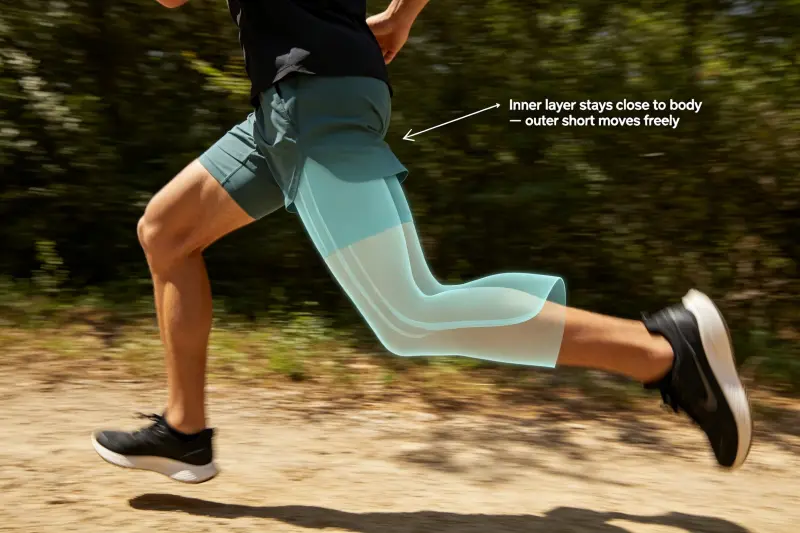
From a garment-construction point of view, coverage is not only about modesty. It is also about how the runner feels when the body changes direction, climbs, sprints, or stretches. A loose running short often has a wide leg opening. This helps airflow and stride movement. But it also means the outer shell can expose more than the runner expects. A fitted inner layer solves that problem without making the outer short heavy.
I often explain this with a simple structure table.
| Short type | Coverage level | Runner feeling | Common use |
|---|---|---|---|
| Single-layer short | Low to medium | Very light | Race day, hot weather |
| Brief liner short | Medium | Traditional support | Daily runs |
| Compression-liner 2-in-1 short | Medium to high | Covered and stable | Training, gym-to-run |
| Separate tights under shorts | High | More layered feel | Cool weather, long runs |
A brand should not assume that more coverage is always better. Some runners want a very minimal race short. Some runners want a clean lifestyle look that can move from gym to road. I usually ask the brand about the target scene first. If the short is for long training, a 7-inch inner liner may make sense. If the short is for hot summer speed work, the same liner may feel too warm.
Are Compression Tights And Ordinary Liners The Same Thing?
Many people use the word “liner” too loosely. I see this cause problems during sampling and product approval.
Compression tights and ordinary liners are not the same. A brief or mesh liner gives basic support and coverage. A compression liner uses stretch fabric, longer length, closer fit, and different seam planning to give a more stable body-hugging feel.
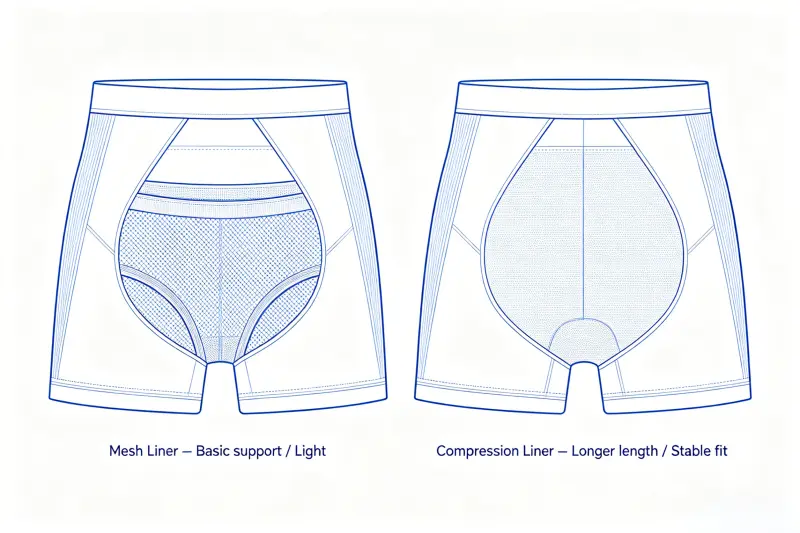
When brands ask us about liners, I first try to define the exact liner type. This saves time in sampling. A standard mesh brief liner is common in basic running shorts. It is light. It dries fast. It gives simple support. But it usually does not cover the thigh. It also does not create the same stable feeling as a fitted compression layer. A compression liner is closer to a short tight inside the outer short. It needs better stretch recovery, better pattern control, and cleaner seam work.
| Feature | Ordinary brief or mesh liner | Compression liner |
|---|---|---|
| Length | Brief length | Mid-thigh or longer |
| Fit | Supportive but not tight on thigh | Close to body |
| Fabric | Mesh or lightweight knit | Stretch knit, often with spandex |
| Main job | Basic support | Coverage, stability, friction control |
| Seam concern | Comfort at brief edge | Comfort along thigh and crotch |
| Pocket option | Limited | Side phone pocket possible |
This difference is important for product cost and brand positioning. A compression liner usually costs more because the fabric is more technical and the construction needs more care. The waistband also matters. If the inner liner pulls differently from the outer shell, the short can twist. I like to test the liner with running motion, not only on a flat table. A sample can look correct, but the runner may feel pressure in the wrong place after movement.
Why Do 2-in-1 Running Shorts Exist?
Runners already wear shorts over tights. I see 2-in-1 shorts as a product answer to that real behavior.
2-in-1 running shorts exist because they combine a loose outer short with a built-in compression liner. This gives runners the look and airflow of shorts with the coverage and stable feel of tights in one garment.
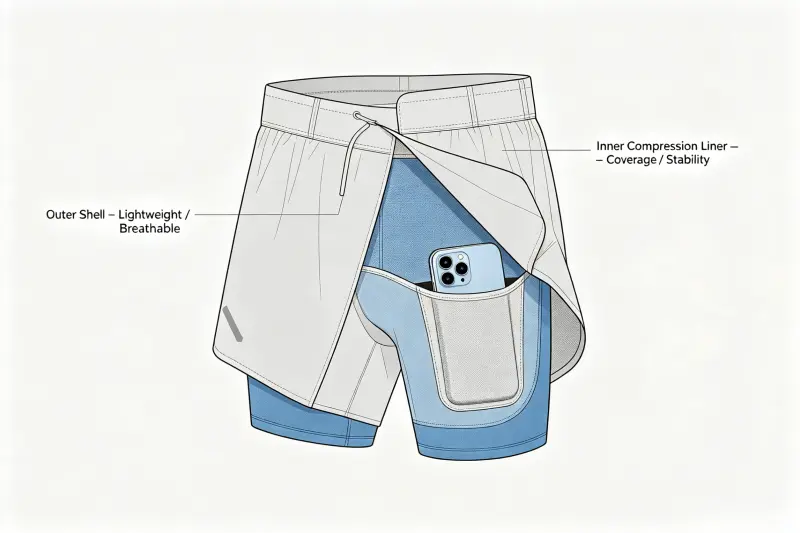
I think 2-in-1 shorts make sense when a brand wants to reduce the need for separate layers. The runner does not need to choose a tight and a short each time. The garment already has both parts. The outer shell can be light and quick-drying. The inner layer can add coverage and a closer fit. This structure is very common in running, gym training, and hybrid activewear.
But I do not treat 2-in-1 shorts as the best answer for every runner. Some runners dislike the extra layer in hot weather. Some runners want to choose different tights for different temperatures. Some race-focused runners prefer a very light split short. So I always connect the structure to the use case.
| Use case | 2-in-1 suitability | Design note |
|---|---|---|
| Daily training | High | Balanced liner and shell |
| Long runs | High | Longer liner may help comfort |
| Gym-to-run | High | Add stable phone pocket |
| Hot race day | Medium to low | Use lighter liner or single layer |
| Cool weather | Medium | Separate tights may offer more warmth |
| Minimal racing | Low | Weight may be too high |
In sampling, I pay close attention to the joining point between the liner and the waistband. If the waistband is weak, the phone pocket may pull down the short. If the liner fabric has poor recovery, the inner layer may stretch out after washing. A good 2-in-1 short is not only two garments sewn together. It is one system.
How Should Brands Choose The Right Inner-Layer Length?
A wrong liner length can make a good short fail. I have seen samples look nice but feel wrong in movement.
Brands should choose inner-layer length based on the running use case, target climate, and customer preference. Short liners feel lighter. Longer liners give more thigh coverage. Mid-length liners often work well for daily training and gym-to-run products.

In custom running shorts development, I usually start with inseam planning. The outer inseam and inner inseam must work together. If the inner liner is much longer than the shell, the product has a clear 2-in-1 look. This can be good for gym and street style. If the liner is only slightly longer, the look is more subtle. If the liner is shorter than the shell, it may not solve thigh rubbing for many runners.
| Inner-layer length | Common feel | Best fit for |
|---|---|---|
| Brief liner | Very light | Basic running shorts |
| 3–4 inch compression liner | Light coverage | Short runs, warm weather |
| 5–7 inch compression liner | Balanced coverage | Daily training, gym-to-run |
| 8 inch or longer liner | Strong coverage | Long runs, cooler days |
I also check the runner body type. A taller runner may need more liner length to cover the same thigh area. A runner with larger thighs may care more about the leg opening and seam stretch. The same listed inseam does not feel the same on every body. This is why a brand should not copy a competitor size blindly. The brand should test the sample on its real customer type. If the target buyer is a DTC running brand customer in the United States or Europe, fit feedback before bulk production can reduce return risk.
How Do Pockets Change The Reason For Wearing Compression Tights?
A bouncing phone can distract any runner. I see pocket stability become a bigger product question every year.
Compression tights or compression liners can help pocket stability because the pocket sits close to the body. This can reduce bouncing compared with a loose outer pocket, especially for phones, keys, cards, or gels.
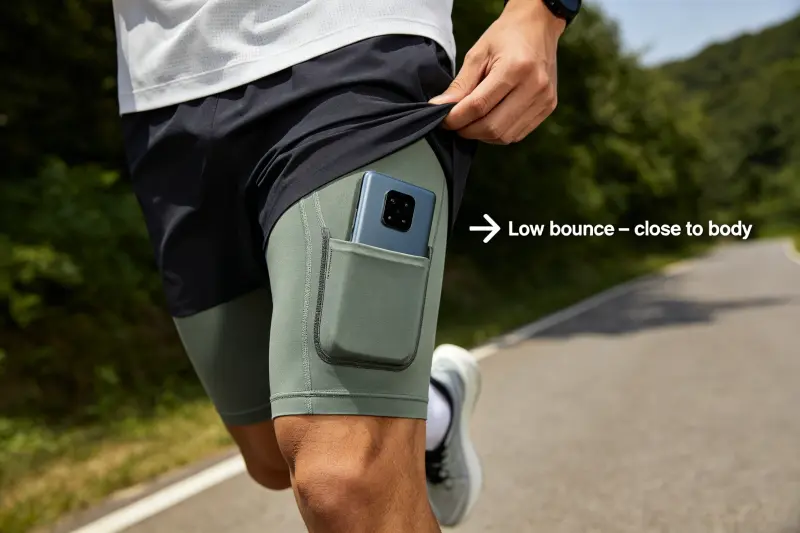
Pocket design is one of the main reasons brands ask for 2-in-1 running shorts. A loose outer short pocket is easy to access, but it can bounce. A back waistband pocket can work well for small items, but it may not fit every phone. A compression liner side pocket can hold the phone close to the thigh. This is why many runners like tights under shorts for longer training.
| Pocket position | Stability | Best item |
|---|---|---|
| Outer side pocket | Low to medium | Casual use |
| Zipper outer pocket | Medium | Keys, cards |
| Back waistband pocket | Medium to high | Gel, card, small phone |
| Compression liner side pocket | High | Phone |
| Inner hidden pocket | Medium | Key |
I design pocket placement with weight in mind. A phone is not just an object. It pulls fabric down with every step. If the liner fabric is too soft, the phone pocket may sag. If the waistband is too loose, the whole short may shift. If the pocket opening is too low, the phone may be hard to reach. For brand founders, this is a clear product choice. If your customer runs with a phone, you may need a compression liner or stronger waistband. If your customer races light, a simple key pocket may be enough.
What Fabric Details Matter Most For Compression Liners?
A liner can look right in photos and still fail in use. I always test the hand feel, stretch, and recovery.
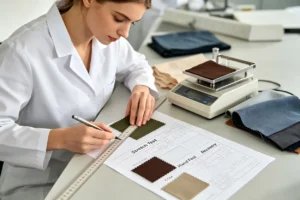
For compression liners, brands should check stretch, recovery, breathability, fabric weight, seam comfort, and drying feel. The fabric should hold the body without feeling too tight or too hot for the target running condition.
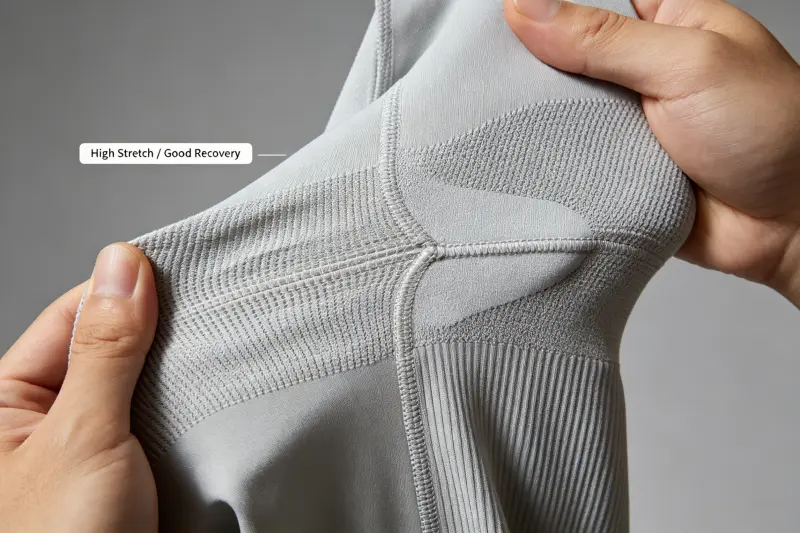
Fabric choice is where many product decisions become real. A high-spandex fabric can give strong support, but it may feel warmer. A lighter knit can breathe better, but it may not hold a phone well. A smooth face can reduce friction. A brushed or heavy surface may feel soft, but it may also trap heat. I do not use one fabric for every short. I match the fabric to the product goal.
| Fabric factor | What I look for | Risk if wrong |
|---|---|---|
| Stretch | Moves with stride | Pulling or restriction |
| Recovery | Returns after wear | Bagging at thigh |
| Breathability | Releases heat | Overheating |
| Weight | Matches climate | Heavy feel |
| Surface | Smooth on skin | Friction |
| Opacity | Covers when stretched | See-through risk |
Seams also matter. Flat seams or clean seam placement can reduce irritation. The inner thigh area needs special care because it moves a lot. The crotch gusset can improve comfort when the runner lifts the knee or squats before a run. The leg opening should hold without cutting into the thigh. If the liner rides up, the whole reason for using it becomes weak. If it grips too hard, the runner may feel pressure. A good compression liner sits between these two problems.
Should Every Running Brand Make 2-in-1 Shorts?
A popular product is not always the right product. I believe brands should choose structure with a clear customer in mind.
Not every running brand needs 2-in-1 shorts. Brands should decide based on target runners, climate, price level, pocket needs, and brand style. Single-layer shorts, brief-lined shorts, and 2-in-1 shorts each serve different jobs.
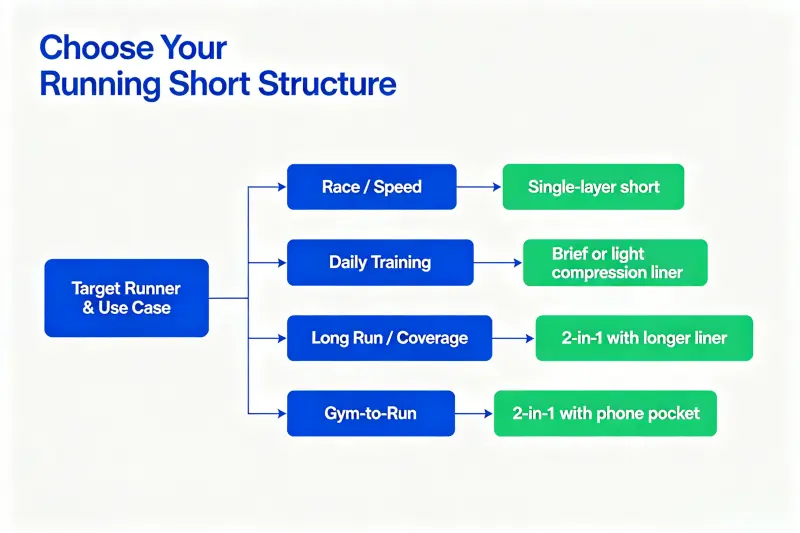
I usually ask brand owners a few simple questions before sampling. Who is the runner? Where do they run? How long do they run? Do they carry a phone? Do they prefer a minimal race feel or a more covered training feel? These answers matter more than a trend photo. A 2-in-1 short can be a strong product for training, gym-to-run, and casual active use. But it can also be too warm, too heavy, or too expensive for another position.
| Brand goal | Better structure to consider |
|---|---|
| Low-weight race short | Single-layer or brief liner |
| Daily running short | Brief liner or light compression liner |
| Long-run comfort | 2-in-1 with longer liner |
| Gym and running crossover | 2-in-1 with phone pocket |
| Budget entry product | Mesh liner short |
| Premium training product | Custom 2-in-1 construction |
As a China-based custom athletic shorts manufacturer, I see the best results when the brand does not ask for “the same as the market.” The brand gets better samples when it defines the use case first. Then we can adjust outer fabric, liner length, waistband strength, drawcord, seam type, pocket placement, and MOQ plan. This is also safer for growing brands. A clear product brief reduces sampling rounds. It also makes quality checks easier during bulk production.
Conclusion
I can help brands customize 2-in-1 running shorts by liner length, stretch fabric, breathability, waistband, seams, and pocket placement for their target runners.