Breathable Sports T-Shirt Fabrics: How Do You Choose the Right Material?
Breathable sports T-shirt fabrics can look perfect on a swatch card, then feel sticky, hot, or heavy during a real workout. That mismatch causes sample delays, buyer complaints, and costly fabric changes. I handle fabric recommendations for OEM/ODM sportswear programs, and the best solution starts with use conditions, not fabric buzzwords.
Breathable sports T-shirt fabrics should be selected by matching sweat rate, climate, activity type, and garment fit to the right knit structure, yarn, stretch level, and moisture finish. GSM alone does not prove breathability. Buyers should test fabric and full garments under target use conditions before confirming bulk production.
A fabric that works for a relaxed team T-shirt may fail in humid HIIT training. A fabric that feels cool during a dry morning run may feel clammy in a tropical summer market. So I use a simple decision framework before I talk about polyester, spandex, rPET, or special cooling yarns.
What Are Breathable Sports T-Shirt Fabrics Really Supposed to Do?
A buyer often asks for “the most breathable fabric,” but that phrase can hide several different problems. The wearer may need more airflow, faster sweat spreading, less cling, lower heat retention, or better dry-out after exercise. If we do not separate these needs early, the fabric brief becomes too vague.
Breathable sports T-shirt fabrics should help heat and moisture move away from the body during activity. In real product development, this depends on knit openness, yarn type, fabric weight, fit, and finishing. A good fabric should feel comfortable during movement, not only pass a supplier’s lab sheet.
Breathability is not one single feature
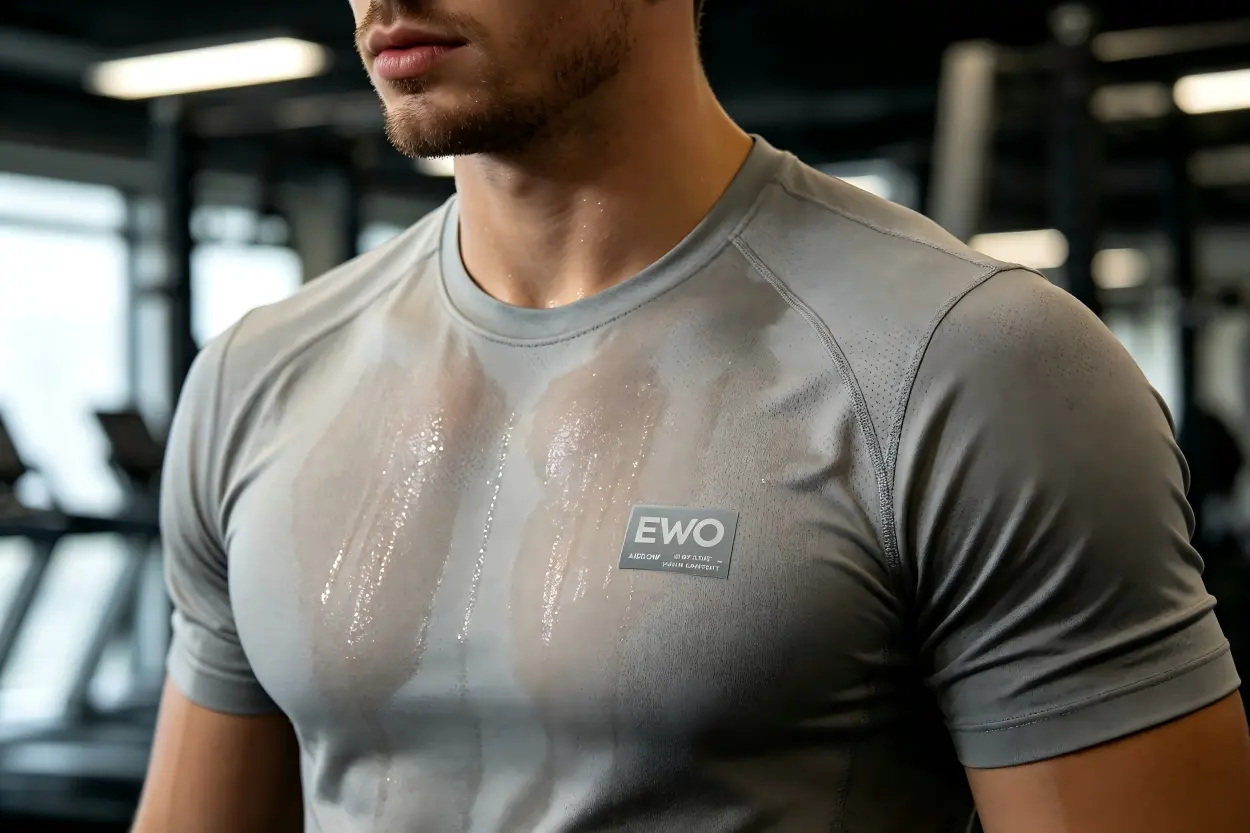
In our factory, one issue we frequently encounter is a sample that feels “breathable” in the hand but becomes stuffy after printing, stitching, and fitting. This happens because breathability is a system. The fabric matters, but the finished T-shirt matters more.
I separate the buyer’s request into four parts:
-
Airflow
Air can pass through the knit structure. This is affected by stitch type, density, and yarn construction. -
Moisture movement
Sweat spreads across the fabric surface instead of staying in one wet area. This is often linked to yarn shape and finishing. -
Dry-out feel
The T-shirt should lose moisture after activity or during cool-down. This matters for running, gym training, and travel sportswear. -
Skin comfort
The fabric should not feel sticky, plastic-like, rough, or heavy when wet.
A supplier may provide air permeability, wicking, or drying test references. These numbers can help buyers compare options, but I treat them as lab-condition references, not final truth. A fabric with strong wicking can still feel clammy in humid weather if evaporation is slow.1 A low-GSM fabric can still block airflow if the knit is dense.
Why GSM alone can mislead buyers
Many buyers start with GSM because it is easy to compare. I understand why. A 120 GSM fabric sounds cooler than a 170 GSM fabric. But GSM only tells us the weight per square meter. It does not tell us how open the knit is.2
| Fabric factor | What it affects | Buyer risk if ignored |
|---|---|---|
| GSM | Weight and opacity | Light fabric may still feel stuffy |
| Knit structure | Airflow and surface texture | Dense knit can trap heat |
| Yarn denier | Hand feel and thickness | Heavy yarn may feel warm |
| Filament count | Smoothness and moisture spread | Poor hand feel after sweating |
| Finish | Wicking and dry-out | Finish may weaken after washing |
| Spandex percentage | Stretch and recovery | Too much stretch can reduce airflow |
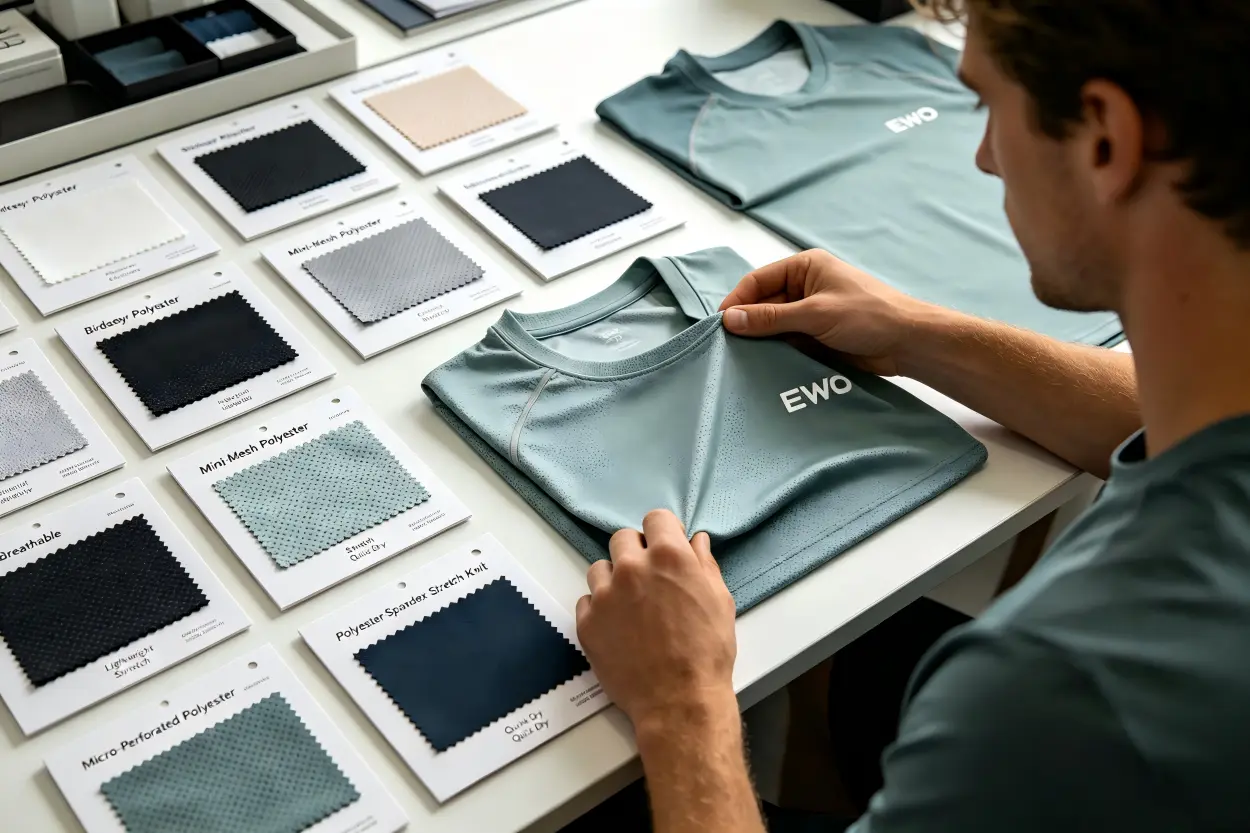
During sample approval, I prefer to compare fabrics on the body, not only on the table. A buyer may approve a mini-mesh because it looks sporty, but the same fabric may show too much transparency in a light color. Another buyer may choose a smooth interlock because it prints well, but it may not release heat well enough for summer running.
My practical definition
For procurement decisions, I define breathable sports T-shirt fabrics like this:
A breathable sports T-shirt fabric is a knit fabric that balances airflow, sweat movement, dry-out speed, stretch, opacity, and hand feel for a specific activity, climate, and fit.
This definition keeps the discussion practical. It also helps prevent keyword-style requests such as “quick dry,” “cooling,” or “ultra-light” from replacing real product requirements.
For brands developing full activewear lines, fabric choices should also stay consistent across tops and bottoms. If your line includes performance tees and shorts, you can review our custom T-shirt manufacturing service and align the fabric story with related products such as running or gym shorts.
How Should Buyers Choose Breathable Sports T-Shirt Fabrics by Sweat, Climate, Activity, and Fit?
A fabric can pass a swatch review and still fail because the buyer chose it for the wrong use case. High-sweat users in humid climates need different performance than casual gym users in dry weather. If the brief ignores this, bulk garments may feel less breathable than the sample promised.
Buyers should choose breathable sports T-shirt fabrics by mapping four conditions first: sweat rate, climate, activity, and fit. This framework helps narrow knit openness, yarn type, stretch percentage, and moisture finish before comparing price, MOQ, colors, and lead time.
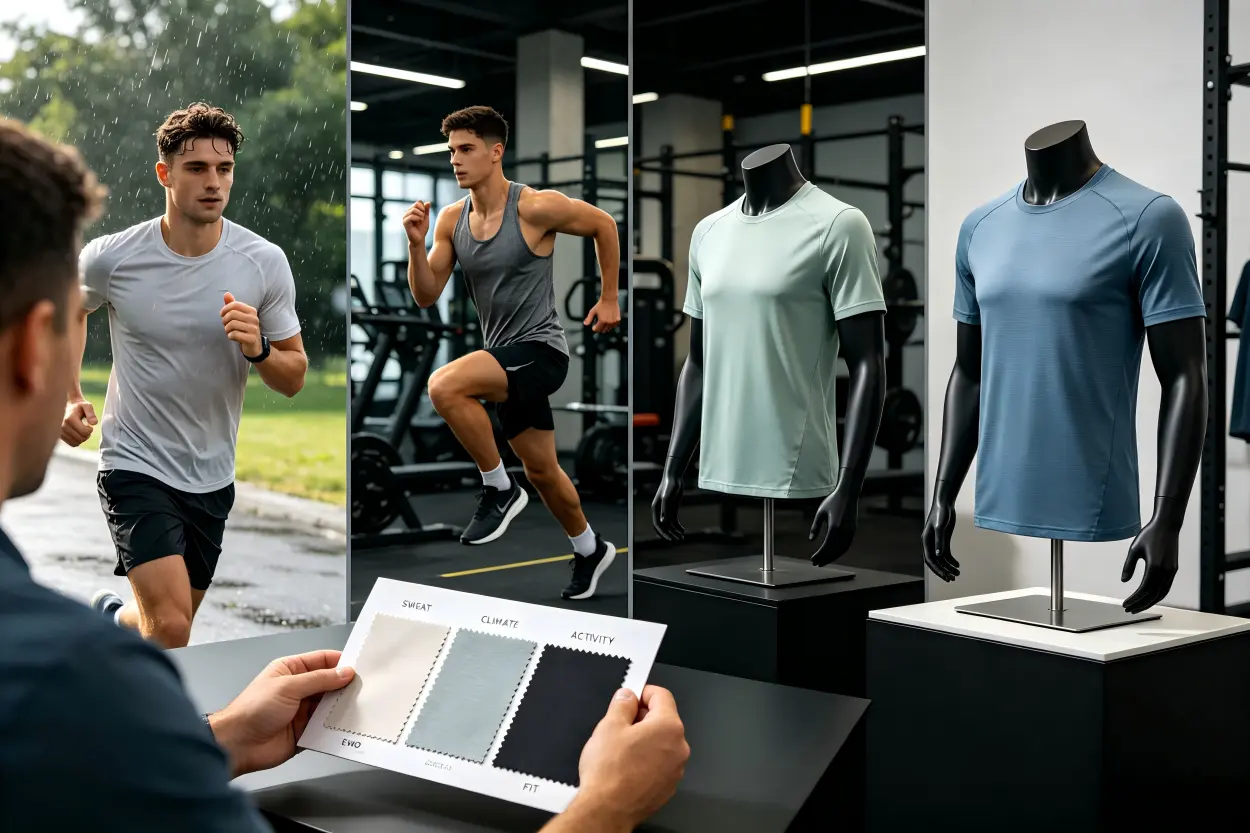
A simple decision framework I use during sampling
During product development, I like to start with a short conversation before fabric sourcing. The goal is not to make the buyer answer technical questions. The goal is to translate the product idea into a fabric direction.
Here is the framework:
| Use factor | Low demand | Medium demand | High demand |
|---|---|---|---|
| Sweat rate | Casual wear, light gym | Training, warm-up | Long runs, HIIT, humid workouts |
| Climate | Cool or dry | Seasonal heat | Hot and humid |
| Activity | Walking, lifestyle | Gym, team sports | Running, HIIT, outdoor summer sport |
| Fit | Relaxed | Regular athletic | Slim compression-like fit |
After this, I can recommend a more realistic fabric family.
Example fabric directions
| Scenario | Better fabric direction | Why it works |
|---|---|---|
| Team T-shirts in hot weather | 100% polyester birdseye or mini-mesh | Stable, cost-friendly, good airflow |
| Road running in summer | Lightweight polyester micro-perf or modified polyester | Better sweat spread and dry-out |
| HIIT training | Poly/spandex knit with controlled stretch | Balances movement and breathability |
| Humid high-sweat use | Modified polyester knit with moisture management | Reduces wet patches and cling |
| Sustainability-focused collection | rPET polyester knit with similar structure and finish | Supports sustainability claims with performance control |
This approach avoids the common mistake of starting with “poly vs cotton.” Cotton can feel cool and soft at rest, but it absorbs sweat and can become heavy under sustained activity.3 Standard polyester can dry faster, but a dense polyester knit may still feel hot.4 Poly/spandex supports movement, but too much spandex can trap heat if the knit is tight.
Fit changes the breathability result
Fit is often ignored, but it changes body feel. A relaxed T-shirt allows more air movement between the skin and fabric. A slim T-shirt holds fabric closer to sweat zones.5 This can make the same material feel wetter.
For slim training tops, I pay close attention to:
- Spandex percentage
- Knit openness
- Underarm comfort
- Chest and back cling
- Recovery after stretching
- Heat-set stability during production
A buyer may request 12% spandex because it feels premium and stretchy. That can work for HIIT or functional training. But if the fabric is dense, the wearer may feel heat build-up after 20–30 minutes. For many training T-shirts, a controlled poly/spandex blend, such as 88–95% polyester with 12–5% spandex, can be more practical than chasing maximum stretch.
Activity changes fabric priorities
Different sports create different stress points.
Running needs:
- Light feel
- Sweat spread
- Fast dry-out
- Low cling
- Comfortable seams
HIIT and gym training need:
- Stretch and recovery
- Abrasion resistance
- Stronger shape retention
- Better movement comfort
Teamwear and promotional sports tees need:
- Stable cost
- Easy decoration
- Color consistency
- Reliable bulk repeatability
This is why one “best fabric” does not exist. The right breathable sports T-shirt fabrics depend on the exact target wearer. I have seen buyers reject a technically good running fabric because it looked too sheer in white. I have also seen buyers accept a slightly heavier fabric because the hand feel, opacity, and after-wash appearance were better for retail.
A buyer checklist before fabric sourcing
Before requesting samples, prepare these details:
- Target market climate: dry heat, humid heat, mixed seasons
- Main use: running, gym, teamwear, lifestyle, outdoor training
- Fit: relaxed, regular, slim
- Expected retail price range
- Color plan
- Logo type and print size
- MOQ flexibility
- Sustainability requirement, if any
- Testing expectation: wear test, wash test, print test
This checklist saves time. It also helps the supplier avoid recommending a fabric that looks good but does not match your commercial limits.
If your brand is still shaping the product concept, our OEM/ODM development process can help connect fabric selection with fit, trims, labels, and packaging from the beginning.
Which Breathable Sports T-Shirt Fabrics Work Best for Different Product Lines?
Many buyers compare fabrics by touch first. That is normal, but touch can be misleading. A cool hand feel in the office does not always mean better performance during sweat. A technical fabric can also feel less impressive at first touch but perform better after 30 minutes of use.
The best breathable sports T-shirt fabrics for most activewear brands fall into four practical groups: lightweight polyester knits, poly/spandex stretch knits, modified polyester moisture-management knits, and rPET polyester knits. Each group has different strengths, cost levels, MOQ limits, and production risks.
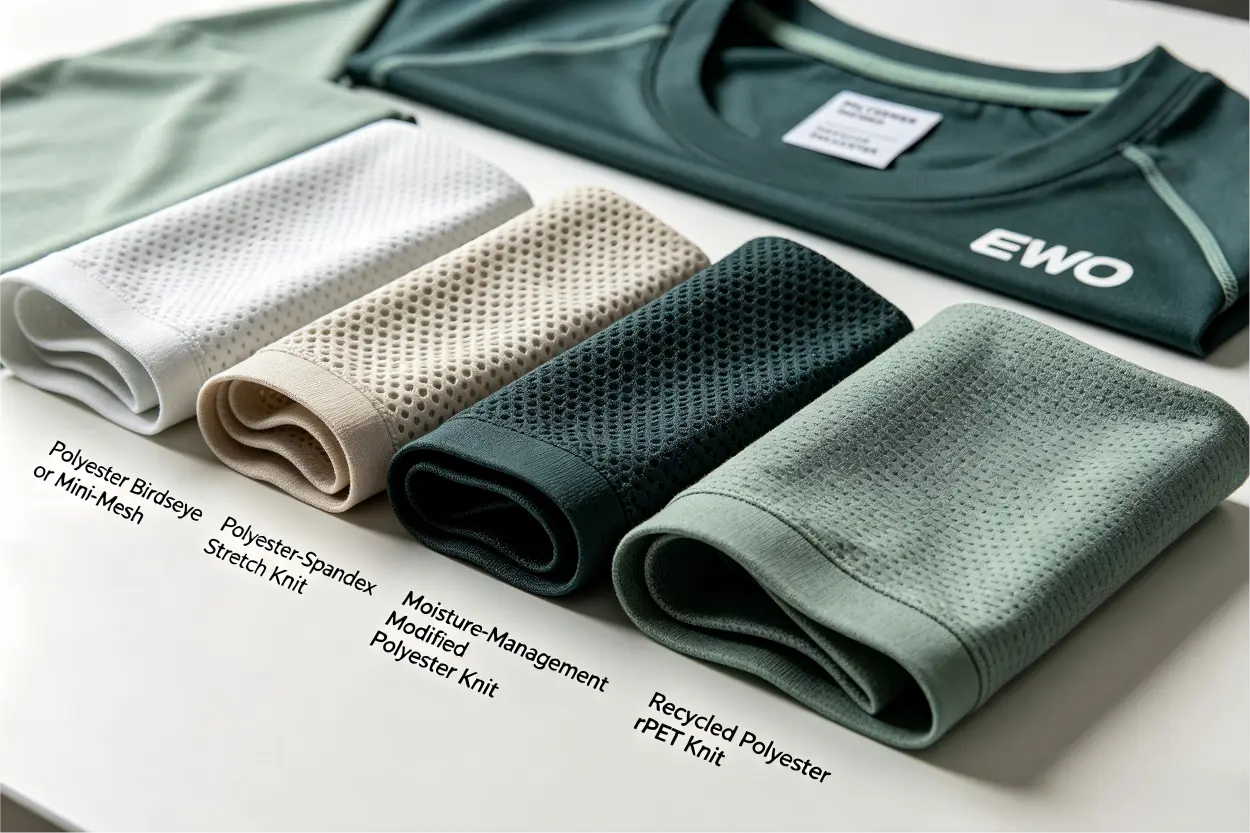
Fabric playbook from OEM sampling work
I do not recommend fabrics by trend name first. I recommend them by how they behave in sampling and repeat production. Below is the practical fabric pool I often consider for sports T-shirt programs.
| Fabric family | Best for | Strengths | Watch-outs |
|---|---|---|---|
| 100% polyester birdseye / mini-mesh / micro-perf | Team tees, running tees, warm-weather basics | Cost-friendly, stable, breathable structure | Large prints can block airflow |
| Poly/spandex 88–95 / 12–5 knits | HIIT, gym, slim training tops | Stretch, recovery, better movement | Dense construction may build heat |
| Modified polyester, Coolmax-equivalent knits | High-sweat running, humid summer use | Better moisture spread and dry-out feel | Higher cost, confirm availability |
| rPET polyester knits | Sustainable activewear lines | Supports recycled material positioning | MOQ, color, and lead time need early confirmation |
100% polyester lightweight knits
For many brands, 100% polyester is still the most practical starting point. It can be stable in production, easier to manage in cost, and suitable for many decoration methods. The key is to select the right structure.
I often look at:
- Birdseye knit for a textured surface and breathable feel
- Mini-mesh for visible openness and airflow
- Micro-perf for a lighter technical look
- Smooth jersey only when print clarity or soft hand feel is more important than maximum airflow
This fabric group works well for road running, team training, and entry-to-mid price activewear. However, the final garment must be tested with the full artwork. A large heat transfer across the chest can turn a breathable fabric into a sweaty front panel.6
Poly/spandex stretch knits
Poly/spandex fabrics are popular because the wearer notices stretch immediately. They work well for gym T-shirts, HIIT tops, and athletic-fit styles. But the buyer must control stretch level.
A higher spandex percentage can improve recovery, but it may also:
- Increase heat retention
- Add cost
- Affect dyeing and heat-setting
- Change shrinkage control
- Reduce the open feel of the knit
For functional training, I prefer to balance stretch and openness instead of selecting the highest spandex content. During A/B wear tests, a slightly less stretchy but more open fabric can feel better after heavy sweating than a dense, very elastic option.
Modified polyester moisture-management knits
Modified polyester fabrics, including Coolmax-equivalent options, can help with moisture spread and evaporation.7 They are useful for humid markets, long runs, and high-sweat users. These fabrics may justify a price premium when the brand sells performance as a clear feature.
But buyers should not accept the claim without checking:
- Fabric construction
- Finish type
- Wash durability expectations
- MOQ by color
- Lead time for greige or dyed fabric
- Compatibility with print and trims
Supplier test data can help, but I still recommend wear testing. Humidity changes everything. If sweat cannot evaporate quickly, even a strong wicking fabric may feel wet against the body.
rPET polyester knits
rPET is useful when the brand needs recycled material positioning. Many DTC and private-label buyers ask for rPET because sustainability is part of their brand story. My advice is simple: do not accept lower comfort just to check the recycled box.
An rPET fabric should be compared against the virgin polyester version for:
- Knit openness
- Hand feel
- Color consistency
- Moisture finish
- Pilling tendency
- MOQ and lead time
- Certification documents from the supplier
Buyers should verify all sustainability documents before making claims on packaging or product pages. The supplier can provide documentation, but the brand should review it carefully and ask qualified professionals if the claim will be used in regulated markets.
Cotton and blends
Cotton is not wrong, but it is often wrong for sustained sweat. It feels natural and comfortable at rest. It can work for lifestyle sportswear or low-intensity training. However, it absorbs moisture and can feel heavy during running or HIIT.
Cotton/poly blends may improve drying compared with 100% cotton, but they still need testing. I would not position them as the first choice for high-sweat performance T-shirts unless the brand’s goal is comfort lifestyle, not intense training.
How Can Printing and Bulk Production Protect Breathable Sports T-Shirt Fabrics?
A buyer may approve the right fabric and still receive bulk T-shirts that feel less breathable. This is frustrating, but it is often preventable. Printing, heat transfers, collar trims, lining choices, and bulk fabric handling can all change how the final garment feels.
To protect breathable sports T-shirt fabrics in bulk production, buyers should test full garments with final artwork, control print coverage, confirm trims, review fabric MOQ by color, and approve samples before scaling. Breathability should be checked after decoration, washing, and real wear, not only on fabric swatches.
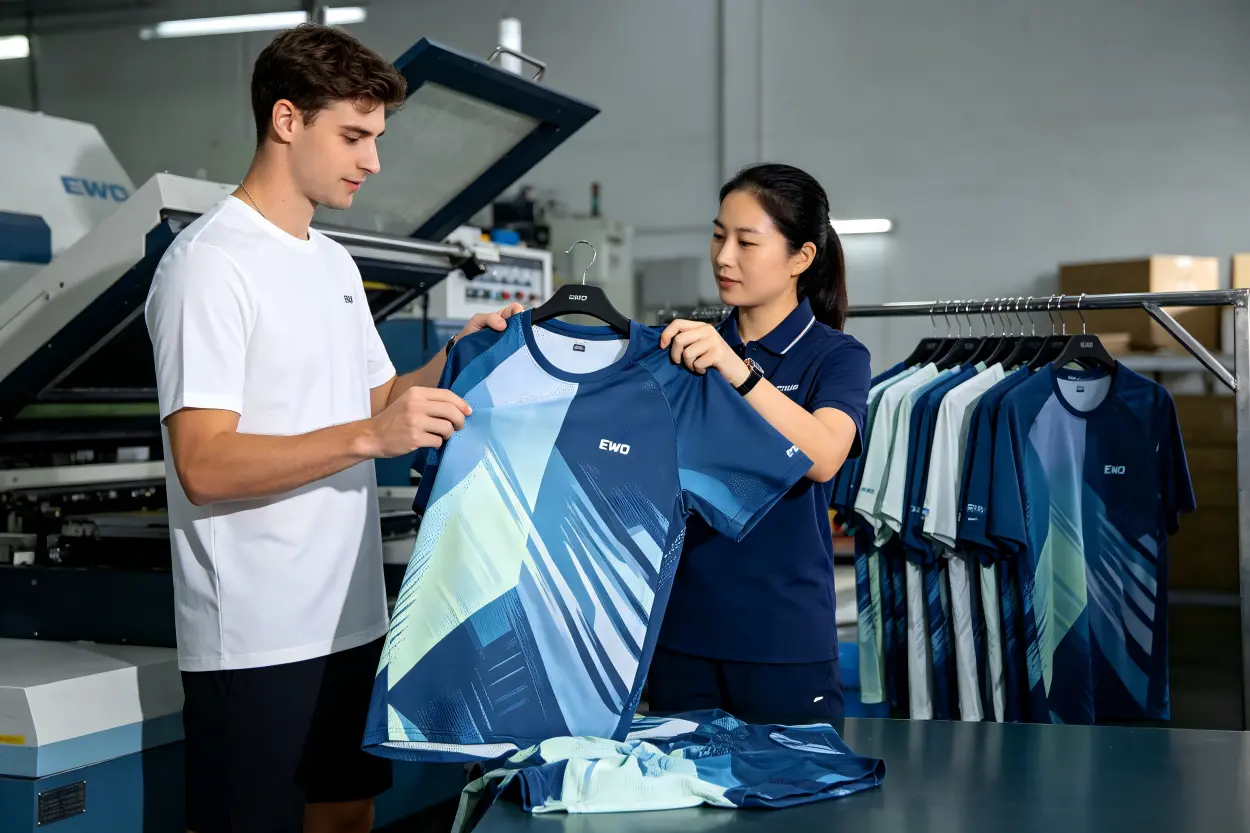
Decoration can reduce airflow
One aftersales issue I have seen more than once is simple: the fabric was breathable, but the print was not. A large plastic-feel heat transfer on the chest or back can block airflow exactly where the wearer sweats most.
For performance T-shirts, I recommend buyers review:
- Logo size
- Logo placement
- Ink thickness
- Transfer type
- Stretch compatibility
- Hand feel after pressing
- Airflow around chest, back, and underarm areas
A small reflective logo near the hem is low risk. A full-width chest graphic is a different problem. If the design requires large artwork, ask for breathable transfers or screen inks with a lower ink lay where possible. Then test the actual garment, not only the print sample.
Trims and construction also matter
Breathability can be affected by small details. A thick rib collar may feel warm on a lightweight running tee. A heavy neck tape can reduce comfort. A dense shoulder panel may trap heat under a backpack or gym bag strap.
During sample review, check:
-
Collar weight
The collar should match the body fabric’s performance level. -
Seam placement
Seams should not rub during repeated movement. -
Label method
Heat-transfer labels may feel cleaner than sewn labels for performance tops. -
Thread and stitching
Stitch quality must support stretch without making the garment feel rigid. -
Fabric shrinkage and twisting
Bulk fabric must remain stable after washing and heat setting.
A/B wear testing that buyers can actually run
A wear test does not need to be complicated. It only needs to match the intended use. For breathable sports T-shirt fabrics, I like a small A/B test with two or three fabric options.
A practical test can include:
- Humid run test: 30–40 minutes if the product targets running
- HIIT test: 20–30 minutes if the product targets gym training
- Cool-down check: How long until the garment feels less wet?
- Sticky zones: Chest, back, and underarms
- After-wash check: Hand feel and drying performance after several washes
Use clear comments rather than vague words. For example:
| Test point | Better feedback | Weak feedback |
|---|---|---|
| Chest feel | “No sticky chest feel after 35 minutes” | “Feels good” |
| Underarm comfort | “No heavy wet patch during HIIT” | “Breathable” |
| Dry-out | “Feels mostly dry after cool-down” | “Quick dry” |
| Print area | “Logo area feels warmer than body fabric” | “Print is okay” |
This kind of feedback helps the supplier adjust fabric structure, finish, or artwork before bulk production.
Bulk production guardrails
During bulk production, buyers should confirm commercial limits before adding too many colors or fabric variants. A fabric that is easy in black may have MOQ problems in neon colors. A special yarn may need longer sourcing time. A modified polyester may cost more than the standard option.
At EWO, our typical workflow is:
- Initial inquiry
- Confirm design
- Sample and approval
- Bulk production
- Quality control
- Packing and shipping
For timing, samples normally take 8–10 working days for production once everything is approved, plus 5–7 days for express shipping. Bulk orders normally take 25–30 working days for production. Shipping often takes 5–7 days by FedEx/DHL express or 10–15 days by air freight.
These timelines can change if the buyer selects special fabrics, custom colors, rPET options, or complex printing. That is why I prefer to confirm MOQ, color plan, and decoration method early. Our standard website positioning is approximately 100 pcs per style, but fabric, color, and customization can affect the final MOQ.
If you want to understand how sampling, production, QC, packing, and shipping connect, you can review our sportswear production process.
What Common Mistakes Cause Breathable Sports T-Shirt Fabrics to Feel Stuffy?
Many fabric problems are not caused by bad suppliers. They are caused by incomplete decisions. A buyer approves one fabric feature and forgets the use case, printing, fit, or bulk color plan. The result is a T-shirt that looked right but did not perform right.
The most common mistakes are equating quick-dry with breathable, choosing only by low GSM, ignoring humid-climate wear tests, using large non-breathable prints, and changing bulk fabric details after sample approval. Buyers can reduce risk with clearer briefs and full-garment testing.
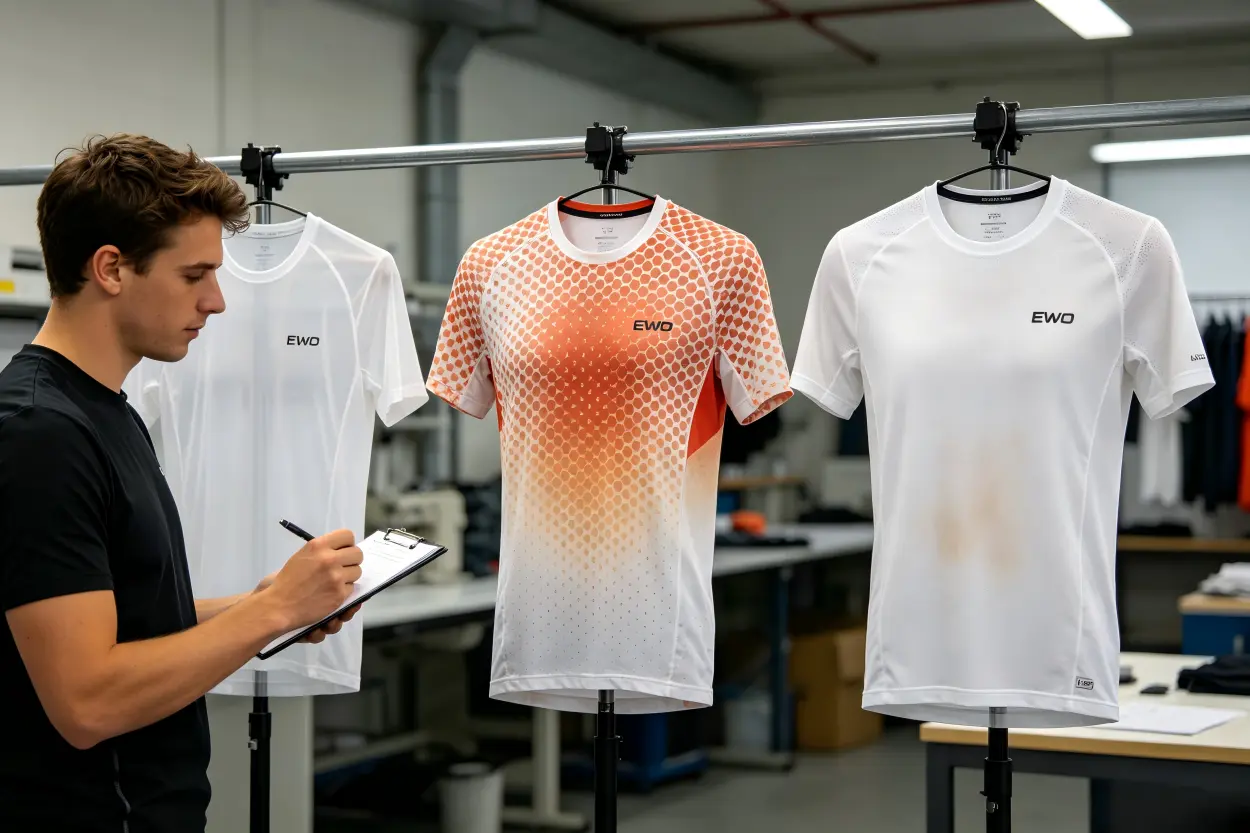
Mistake 1: Treating “quick-dry” as the same as breathable
Quick-dry and breathable are related, but they are not the same. A quick-dry finish can move moisture across the fabric. Breathability also depends on airflow and heat release. In humid conditions, sweat may spread but not evaporate fast enough. The shirt can still feel clammy.
A better question is:
Will this fabric feel comfortable on the target wearer during the target activity in the target climate?
That question is harder than reading a label, but it prevents poor fabric selection.
Mistake 2: Chasing the lowest GSM
A very light fabric can be useful, but it can also create problems:
- Transparency in white or light colors
- Poor collar stability
- Less premium hand feel
- Print show-through
- Reduced durability
- Cling when wet
Sometimes a slightly heavier mini-mesh or birdseye fabric feels better because the structure releases heat while still giving coverage. A buyer should compare body feel, opacity, and recovery, not only weight.
Mistake 3: Ignoring artwork during fabric approval
The fabric swatch is not the final garment. A large chest print, back print, silicone badge, or thick heat transfer can change the wearing experience. If the brand needs bold graphics, the fabric choice and print method must be developed together.
Practical steps:
- Approve fabric swatches first.
- Make a sample with the real logo size.
- Wear test the sample.
- Wash test the sample.
- Confirm print hand feel and stretch.
- Approve bulk only after full-garment review.
Mistake 4: Not checking repeat production
Repeat production matters for growing brands. A fabric should not only work once. It should be available again, match previous hand feel, and support future colors.
For repeat programs, I recommend buyers ask:
- Is the fabric a regular stock-supported construction?
- What is the MOQ by color?
- Can the supplier repeat the same finish?
- Will rPET or modified yarn need longer lead time?
- Can the trim and print method stay consistent?
- Are shade bands acceptable for future orders?
These questions are practical. They protect the brand from “sample-breathable but bulk-stuffy” outcomes.
Mistake 5: Forgetting the full product line
Many buyers develop T-shirts separately from shorts. That can create a mismatch. A very technical top paired with a basic short may look inconsistent. A lifestyle cotton-touch top paired with performance running shorts may confuse the customer.
If your brand sells gym sets, running sets, or training collections, align fabric hand feel, color, trims, and use case across categories. For example, a breathable running tee can pair with lightweight shorts from a custom gym and running shorts manufacturer to create a more consistent product story.
Frequently Asked Questions
What is the best fabric for breathable sports T-shirts?
The best fabric depends on sweat rate, climate, activity, and fit. For many activewear brands, 100% polyester birdseye, mini-mesh, or micro-perf fabrics are practical choices. For HIIT, poly/spandex blends can work better. For humid running, modified polyester moisture-management fabrics may perform better.
Is lower GSM always better for breathability?
No. Lower GSM means lighter weight, but it does not guarantee better airflow. Knit structure, yarn type, density, and finishing are also important. A slightly heavier open-knit fabric can feel more breathable than a lighter dense fabric, especially during sweat-heavy activity.
Are quick-dry T-shirts always breathable?
No. Quick-dry fabrics help move or release moisture, but breathability also includes airflow and heat comfort. A quick-dry T-shirt can still feel clammy in humid weather if the fabric structure or garment design traps heat.
Can large logo prints reduce T-shirt breathability?
Yes. Large heat transfers, thick screen prints, or rubberized graphics can block airflow and create warmer zones on the chest or back. Buyers should test the final artwork on a finished garment before approving bulk production.
Is rPET polyester good for breathable sports T-shirts?
rPET polyester can work well if the knit structure, finish, and hand feel match the performance target. Buyers should compare it with virgin polyester options and confirm MOQ, lead time, color availability, and certification documents before making sustainability claims.
Conclusion
Breathable sports T-shirt fabrics should not be selected by label, GSM, or hand feel alone. I recommend starting with sweat rate, climate, activity, and fit, then matching those needs to knit structure, yarn, stretch, finish, and decoration method. Full-garment wear testing is the safest way to avoid clammy, stuffy, or inconsistent bulk results. If you are developing custom performance T-shirts, you can contact us to send your tech pack, request fabric recommendations, or discuss a sample.
"The effects of a systematic increase in relative humidity on ...", https://pmc.ncbi.nlm.nih.gov/articles/PMC5079215/. Exercise thermoregulation literature shows that high ambient humidity reduces the vapor-pressure gradient for sweat evaporation, limiting evaporative heat loss and increasing perceived wetness; this supports the article’s caution, though it does not evaluate a particular branded wicking finish. Evidence role: mechanism; source type: paper. Supports: The source should explain that evaporative cooling and drying are reduced when ambient humidity is high. Scope note: Contextual physiological support rather than a product-specific fabric trial. ↩
"Fabric Weight - an overview", https://www.sciencedirect.com/topics/engineering/fabric-weight. A textile testing reference defines fabric mass per unit area as a weight measurement and treats air permeability as a separate property determined by structural features such as porosity and construction; this supports the distinction between GSM and breathability, although it does not rank any specific sports T-shirt fabric. Evidence role: definition; source type: research. Supports: The source should define GSM or fabric mass per unit area and explain that air permeability or porosity depends on fabric structure rather than mass alone. Scope note: Contextual support for the measurement distinction, not direct proof about every knit used in sports T-shirts. ↩
"Liquid Moisture Transport in Cotton Woven Fabrics with ... - PMC", https://pmc.ncbi.nlm.nih.gov/articles/PMC9504572/. Textile references report that cotton has substantially higher moisture regain than polyester, which helps explain why cotton garments can retain sweat and feel heavier during prolonged activity; this is material-property support, not a complete wearer-comfort test for every cotton T-shirt. Evidence role: general_support; source type: research. Supports: The source should support cotton’s relatively high moisture regain or absorption and its implications for wet comfort during activity. Scope note: General material-property support; comfort also depends on knit, garment fit, and conditions. ↩
"(PDF) Cotton clothing comfort compared to polyester", https://www.academia.edu/8151344/Cotton_clothing_comfort_compared_to_polyester. Textile studies associate polyester’s low moisture regain with faster drying than cotton and separately show that denser knitted structures can reduce air permeability; together these findings support the article’s distinction between fiber type and garment heat comfort. Evidence role: general_support; source type: paper. Supports: The source should support polyester’s low moisture regain or faster drying and show that fabric density or structure affects air permeability and thermal comfort. Scope note: Synthesis of related findings rather than a single test of all polyester sports T-shirt constructions. ↩
"The Role of Sports Clothing in Thermoregulation, Comfort ...", https://pmc.ncbi.nlm.nih.gov/articles/PMC9051004/. Clothing comfort research identifies the air gap and microclimate between skin and fabric as important determinants of heat and moisture transfer; this supports the claim that relaxed and slim fits can make the same fabric feel different. Evidence role: mechanism; source type: paper. Supports: The source should show that clothing fit and the skin-fabric air layer influence ventilation, heat transfer, and moisture comfort. Scope note: General clothing-comfort evidence; exact effects depend on body movement, fabric elasticity, and garment pattern. ↩
"Assessment of the Impact of the Surface Modification ...", https://pmc.ncbi.nlm.nih.gov/articles/PMC8962984/. Research on printed and coated textiles indicates that added surface layers can lower air permeability and moisture-vapor transmission compared with the unprinted base fabric; this supports the risk of large heat-transfer graphics, while the magnitude depends on ink or film chemistry and coverage area. Evidence role: mechanism; source type: paper. Supports: The source should show that surface printing, coatings, or heat-transfer films can reduce air permeability or moisture vapor transmission. Scope note: General support for printed/coated textiles; specific transfer materials require direct garment testing. ↩
"Design and Coupled Moisture–Thermal Transfer Simulation of ...", https://pmc.ncbi.nlm.nih.gov/articles/PMC11396311/. Textile research on engineered polyester fibers reports that modified cross-sections and capillary channels can improve liquid moisture transport and drying behavior; this supports the general claim about modified polyester, without verifying any particular supplier’s Coolmax-equivalent product. Evidence role: mechanism; source type: paper. Supports: The source should explain that engineered polyester cross-sections or modified yarn structures can enhance capillary transport and drying. Scope note: Supports the design principle, not the performance of a specific commercial fabric. ↩