[US vs EU import duties for custom gym shorts can turn a clean factory quote into a confusing landed-cost calculation. A buyer may see a fair unit price, then face duty, VAT, freight, insurance, and customs fees later. The safest solution is to check import-cost responsibility before sampling, pricing, or approving bulk production.
US vs EU import duties for custom gym shorts should be treated as a landed-cost risk check, not a single tax-rate search. Buyers need to confirm destination, fabric composition, product use, shipping method, order stage, and trade terms with their customs broker or import agent before they compare supplier quotes or approve production.
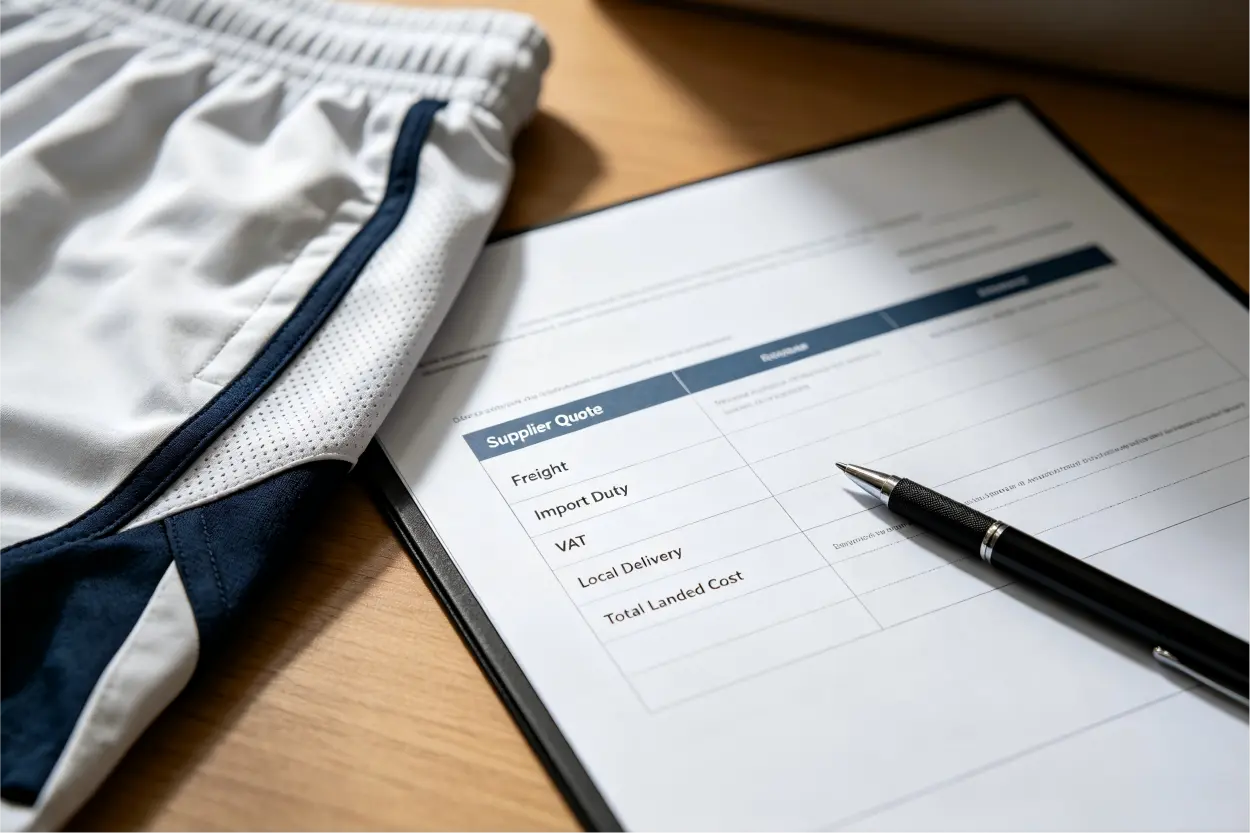
Many buyers ask me, "What is the duty?" before they have finalized the fabric, destination, or shipping method. I understand why. Import cost affects retail pricing, first-order budget, and delivery planning. But the better question is: what will this order cost after it arrives and clears customs?
Why Do US vs EU Import Duties for Custom Gym Shorts Change the Landed Cost?
A low unit price can feel safe at first. Then freight, insurance, customs clearance, duty, VAT, and local delivery appear one by one. That gap can hurt a startup's first launch or a wholesaler's margin. I prefer to discuss these cost layers before a buyer confirms the order.
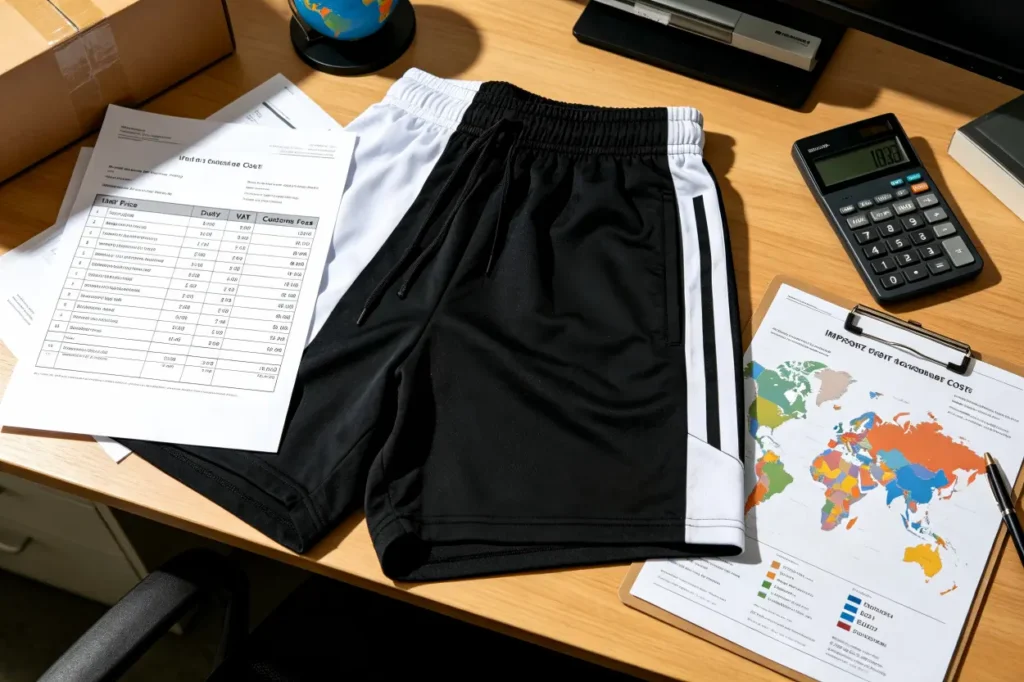
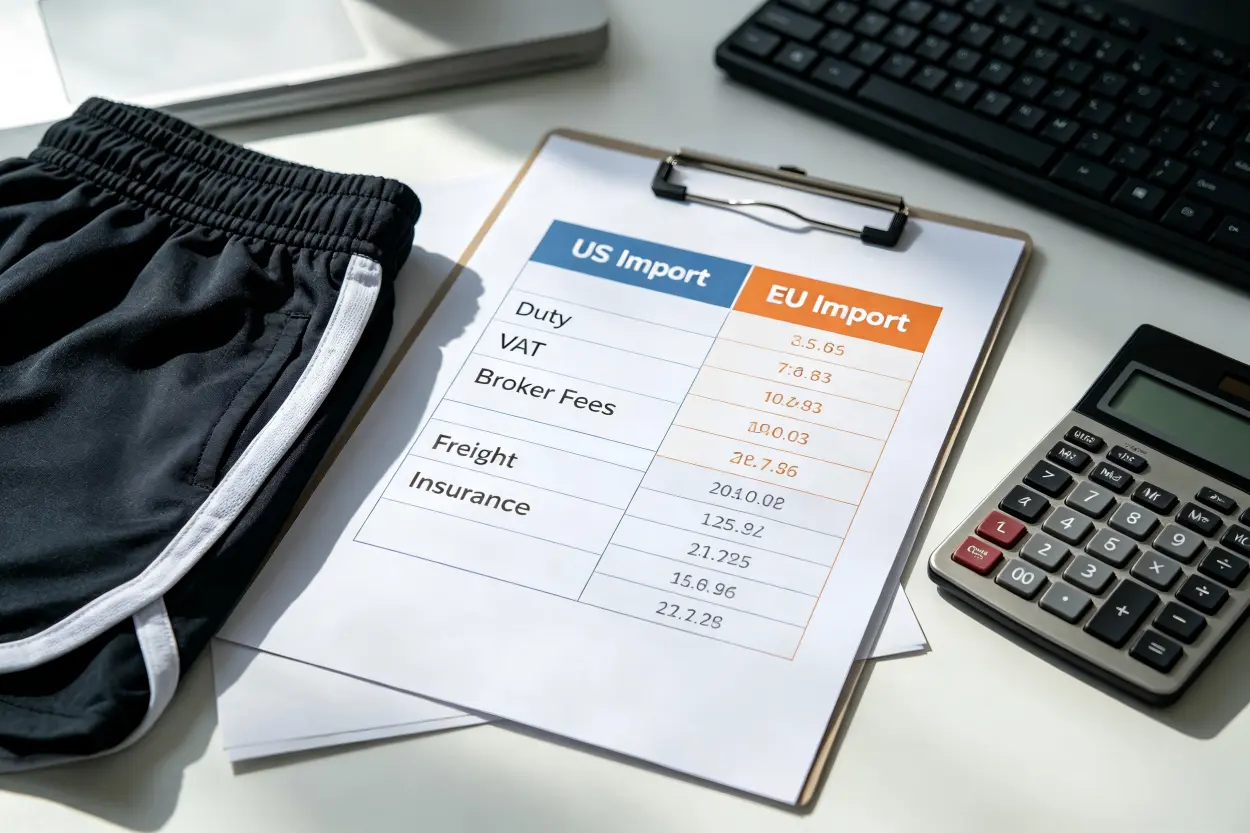
US vs EU import duties for custom gym shorts change landed cost because each market applies its own customs rules, taxes, clearance process, and responsibility structure. The supplier quote is only one part of the final cost. Buyers should compare total landed cost, not only the factory unit price.
Supplier price is not the final buyer cost
In our factory quotation discussions, I often explain that an FOB or EXW price is not the same as the final cost in the buyer's warehouse. The factory price usually reflects the garment itself and the agreed production terms. It does not automatically include every destination-side cost.
For custom gym shorts, the landed cost may include:
- Product unit price
- Sample cost or development cost
- Export packing
- Freight
- Cargo insurance
- Import duty
- VAT or destination taxes
- Customs broker or clearance service fees
- Local delivery after customs clearance
- Bank charges or payment service fees
- Inspection or testing costs, if required
That is why I encourage buyers to separate the cost into two parts:
| Cost Area | Usually Discussed With Supplier? | Usually Verified Locally? |
|---|---|---|
| Unit price | Yes | Sometimes |
| Fabric and trims | Yes | No |
| Export carton details | Yes | Sometimes |
| International freight | Sometimes | Yes |
| Import duty | No final guarantee | Yes |
| VAT or destination tax | No final guarantee | Yes |
| Customs clearance fees | No final guarantee | Yes |
| Local delivery | Sometimes | Yes |
The US and EU do not follow the same cost logic
A US buyer and an EU buyer may order the same training shorts from the same China factory. The fabric, logo, packaging, and quantity may be identical. Even then, the import-cost calculation can differ because the destination market is different.
For example, an EU buyer often needs to pay close attention to VAT treatment, the destination member state, and the importer of record. A US buyer may focus more on the import classification, customs entry, and any applicable destination-side fees. I do not give final tax advice, because that belongs with a qualified customs broker or import agent. But I can help buyers prepare the correct product details for that conversation.
A practical landed-cost mindset
During OEM discussions for custom gym and running shorts, I suggest that buyers estimate landed cost before they confirm a bulk order. That estimate does not need to be perfect at the inquiry stage. It does need to be realistic enough to protect pricing.
A simple landed-cost check can answer these questions:
- Can the product still meet the target retail price?
- Can the buyer afford the first bulk order after freight and import costs?
- Will customs responsibility be clear under the selected trade term?
- Will the delivery timeline still match the launch plan?
- Will a reorder remain profitable if freight or tax treatment changes?
The main risk is not only paying more than expected. The bigger risk is building a price structure on incomplete information.
What Product Details Affect Import Duties for Custom Gym Shorts?
A buyer may want one quick answer, but custom sportswear rarely works that way. Fabric, construction, product description, and order stage can all affect how the shipment should be reviewed. Missing details can lead to wrong assumptions before customs clearance.
Product details that may affect import duties for custom gym shorts include fabric composition, woven or knitted construction, intended use, lining, waistband design, order value, destination, sample or bulk status, and shipping method. Buyers should give these details to their customs broker before relying on any import-cost estimate.
Fabric composition matters more than many buyers expect
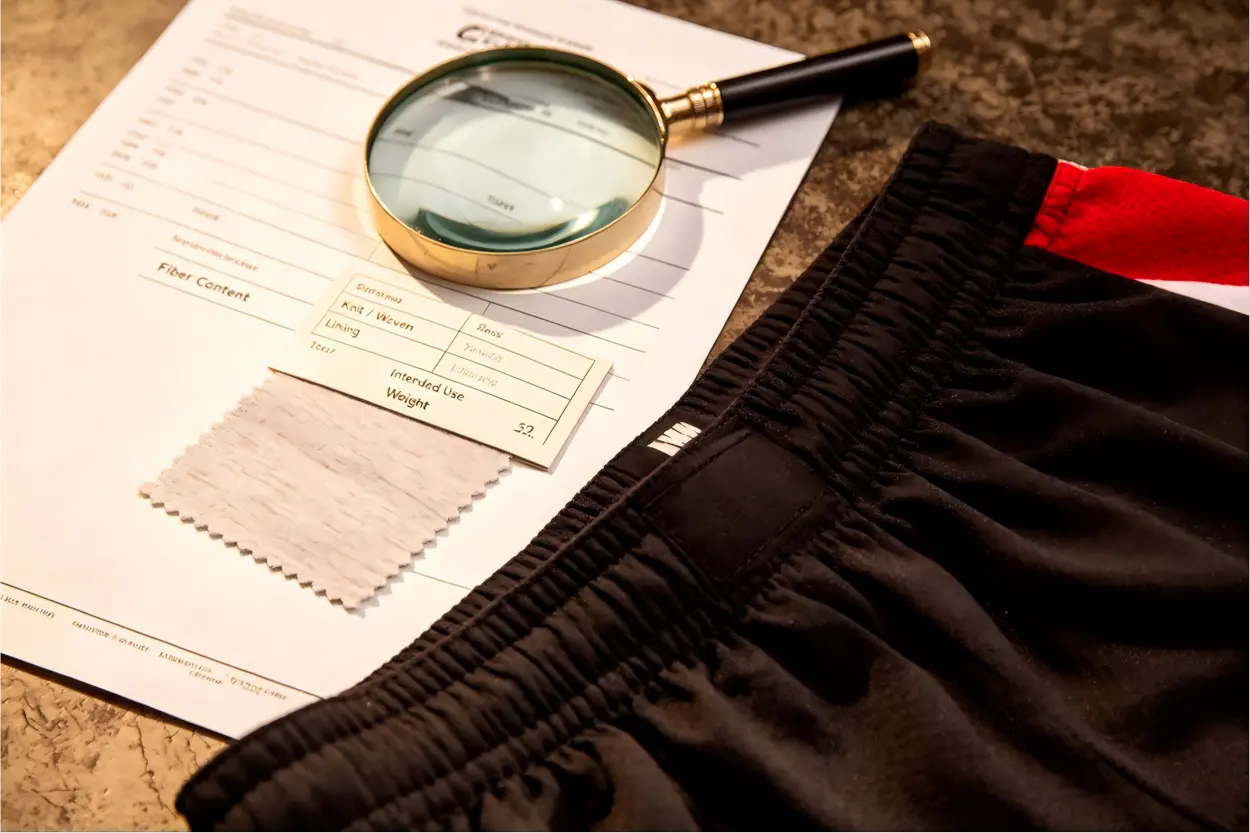
In product development, fabric is not only a performance choice. It can also affect how the product is described for customs review. A polyester-spandex gym short is not the same as a cotton-blend casual short. A mesh basketball short may not be reviewed the same way as a lined compression-style training short.
For procurement planning, I recommend that buyers prepare a basic specification sheet before asking for import guidance. It should include:
- Main fabric composition, such as polyester, nylon, cotton, spandex, or blends
- Fabric construction, such as woven or knitted
- Fabric weight, if available
- Lining details, if the short has inner brief, compression liner, or mesh lining
- Waistband type, such as elastic waistband, drawcord, or flat waistband
- Pocket design
- Logo method, such as heat transfer, embroidery, screen print, or woven patch
- Intended use, such as gym training, running, basketball, boxing, or teamwear
These details help the customs broker or import agent check the product more accurately. As a manufacturer, I can provide garment specifications, packing details, and material information. I cannot guarantee final classification or payable duty.
Sample, first bulk order, and reorder are not the same
The order stage also matters. A buyer may treat a sample shipment casually because the quantity is small. But the first bulk order carries more financial risk. A reorder may look simple, yet it can still change if the fabric, destination, or shipping method changes.
Here is how I view the stages from a factory side:
| Order Stage | Main Buyer Goal | Import-Cost Risk |
|---|---|---|
| Sample order | Confirm fit, fabric, logo, workmanship | Low value, but timing and courier fees matter |
| First bulk order | Launch product and protect budget | Highest risk because assumptions are untested |
| Reorder | Maintain supply and margin | Risk rises if specs, freight, or destination changes |
For samples, our usual production time is 8–10 working days once everything is approved, and express shipping often takes 5–7 days. For bulk orders, production usually takes 25–30 working days. Express shipping is often 5–7 days, while air freight can take 10–15 days. These timelines help buyers plan launch dates, but customs clearance time and local handling still need separate checking.
Product variables can change the business decision
A buyer may ask for a lower fabric cost to improve margin. That can work, but it should not be the only decision point. A cheaper fabric may affect handfeel, durability, opacity, shrinkage, or brand positioning. In some cases, it may also change how the product is described for import review.
During sample approval, I prefer to lock the following items before a buyer asks their customs broker for final guidance:
- Confirmed fabric
- Confirmed size range
- Confirmed logo method
- Confirmed packing method
- Estimated quantity
- Destination country and city
- Preferred trade term
- Preferred shipping method
If these details keep changing, the import-cost estimate may keep changing too. That is why a good pre-order process saves more money than a rushed quote.
How Should US Buyers Check Import Duties for Custom Gym Shorts?
Some US startups focus heavily on the factory unit price because it feels like the easiest number to control. Later, they may discover that freight, customs entry, and destination fees affect their launch budget. I prefer to make the cost boundary clear before production begins.
US buyers should check import duties for custom gym shorts by confirming product specifications, destination, order value, trade terms, and shipping method with a licensed customs broker or import agent. A China supplier can provide product and packing information, but the buyer should verify final classification and payable charges locally.
Start with the importer responsibility
For US buyers, the first practical question is not "What is the duty?" The first practical question is:
Who is responsible for customs clearance and destination-side costs?
That answer depends partly on trade terms. Many apparel buyers use terms like EXW, FOB, CIF, DAP, or sometimes DDP. Each term changes cost responsibility and risk boundaries. I do not recommend that buyers rely only on informal wording in chat. The trade term should be clear on the quotation, proforma invoice, and order confirmation.
A simple comparison helps:
| Trade Term | Buyer Should Check | Supplier Boundary |
|---|---|---|
| EXW | Export pickup, freight, customs, local delivery | Factory makes goods available |
| FOB | Ocean/air export handover point, import costs | Supplier handles export-side handover |
| CIF | Insurance and freight to named port/airport | Import clearance still needs buyer attention |
| DAP | Delivery to named destination before import duties/taxes | Buyer may still handle import charges |
| DDP | Delivered with duty paid, if truly arranged | Buyer must verify what is included and who acts as importer |
DDP may sound simple, but I advise buyers to confirm details carefully. Some DDP offers are convenient for small orders, but they may not fit every commercial import situation. A broker or import advisor can help decide what is suitable.
Prepare the right documents and details
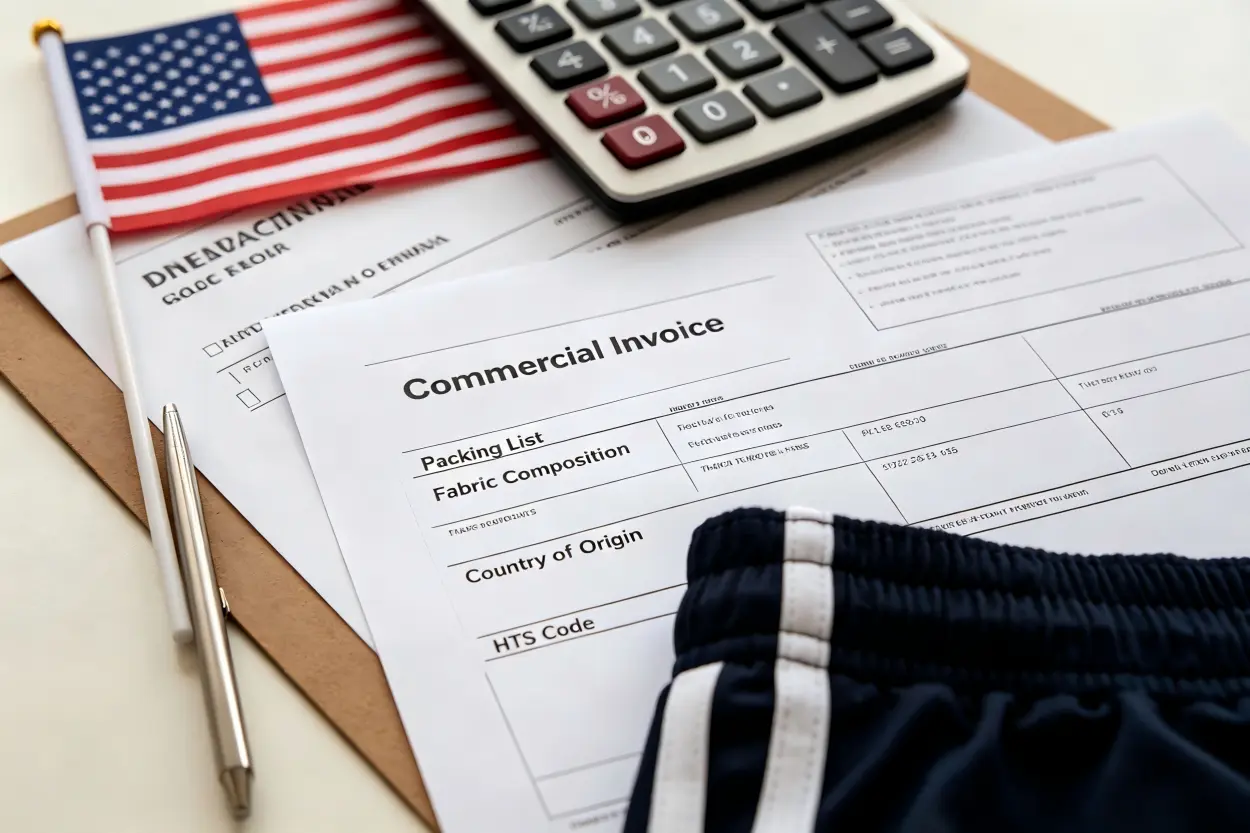
Based on our OEM experience, a US buyer's broker may ask for practical documents and product information. The factory can usually support many of these items.
Common items include:
- Commercial invoice
- Packing list
- Product description
- Fabric composition
- Unit price and total value
- Carton quantity, weight, and dimensions
- Country of origin
- Buyer and seller information
- Shipping method
- Logo or brand details, if relevant
For custom sports shorts, I also suggest keeping the tech pack consistent with the commercial invoice description. If the product is a gym short, training short, or running short, the description should match the real garment. Vague labels can create confusion.
If buyers are still building the product, our OEM/ODM customization process can help organize fabric selection, logo method, sample approval, and bulk production details before shipping documents are prepared.
Common mistakes US buyers make
One issue that appears often is budget planning based only on the supplier's EXW or FOB price. The buyer then adds a rough freight number but leaves duty and customs fees out of the calculation.
Common mistakes include:
- Assuming the supplier unit price is the landed cost
- Using one old duty estimate for a new fabric
- Ignoring customs broker fees
- Choosing express shipping without checking total import cost
- Treating samples and bulk orders the same
- Changing product specs after receiving import guidance
- Not confirming who is importer of record
A more careful process does not slow the project very much. It usually prevents worse delays later. During product development, I like to give buyers enough garment information so they can ask the right local questions before they commit to a launch quantity.
How Should EU Buyers Check Import Duties for Custom Gym Shorts?
EU buyers face another layer of complexity because the destination is not simply "Europe." The member state, VAT process, importer setup, and local clearance practice can all matter. A wholesaler in one country may not have the same cost flow as a brand in another.
EU buyers should check import duties for custom gym shorts by confirming the destination member state, VAT treatment, importer responsibility, fabric details, shipment value, and delivery terms with their customs broker or import agent. The EU market should not be treated as one single cost model for every buyer.

The EU is one market, but not one simple invoice
EU buyers often ask whether the import cost is "the same for Europe." I understand the question, but it can be risky. The EU has shared customs structures in many areas, yet the buyer's country, VAT registration, logistics route, and import setup still affect the final landed cost and cash flow.
For example, a sportswear brand importing into Germany may have different administrative steps than a wholesaler importing into France, Spain, the Netherlands, or another member state. I avoid giving universal answers because they may mislead the buyer.
Instead, I suggest that EU buyers confirm:
- Destination country
- Importer of record
- VAT registration position
- Delivery address
- Port, airport, or courier route
- Product value
- Fabric composition
- Trade term
- Whether the shipment is a sample, first bulk order, or reorder
These points help the buyer's customs broker or import agent evaluate the shipment properly.
VAT can affect cash flow
For EU buyers, VAT is often a major landed-cost and cash-flow issue. Even when a business can later reclaim VAT, the timing and documentation may still matter. I do not advise buyers on tax recovery, because that depends on their local tax position. But I do remind them to include VAT handling in their pre-order budget review.
A first-time importer may focus only on customs duty and forget VAT, customs service fees, and local delivery. This can create a surprise payment before goods are released. For a startup launching a small gymwear line, that surprise can affect marketing spend, stock planning, and cash flow.
EU buyers should align product specs before checking costs
Custom gym shorts can vary widely. A running short with lightweight woven fabric, inner brief, and reflective logo is different from a heavy training short with side pockets and a thick waistband. A boxing-inspired short or teamwear short may have different construction and branding needs.
If a buyer is comparing several sportswear styles, I suggest checking import-cost assumptions style by style. A single estimate may not fit every garment.
For example:
| Product Type | Common Variable to Confirm | Buyer Risk If Ignored |
|---|---|---|
| Gym training shorts | Fabric blend, pocket design, waistband | Wrong product description |
| Running shorts | Liner, lightweight woven fabric, reflective trim | Incomplete specification |
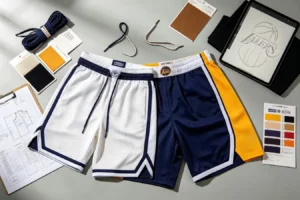
| Basketball shorts | Mesh fabric, length, team logo | Different construction details |
| Boxing shorts | Satin/poly fabric, wide waistband | Style may need clearer description |
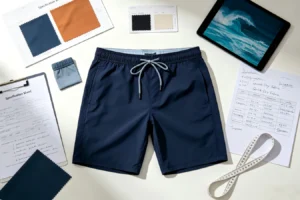
| Board-style shorts | Woven fabric, closure, water-use positioning | Intended use may be unclear |
For buyers developing multiple styles, our production process page explains how we move from material confirmation to sampling, approval, and bulk production. That sequence also helps buyers prepare accurate import documents later.
Do not compare EU and US costs too casually
A buyer may say, "My US partner paid this amount, so my EU cost should be similar." That comparison can be misleading. The destination tax structure, customs handling, logistics route, and buyer registration can differ.
A better comparison is:
- Same product?
- Same fabric composition?
- Same order quantity and value?
- Same shipping method?
- Same trade term?
- Same importer responsibility?
- Same destination tax treatment?
If several answers are "no," the landed cost may not be comparable. This is why I do not present the US or EU as always cheaper or easier. The right answer depends on the exact order.
What Should Buyers Confirm Before Sampling or Bulk Ordering Custom Gym Shorts?
Many problems begin before production, not during production. A buyer may approve a sample, plan a launch price, and then check import costs too late. That sequence creates avoidable risk. I prefer to put the customs-cost discussion into the buying process early.
Before ordering custom gym shorts, buyers should confirm destination, fabric composition, order stage, target quantity, shipping method, trade terms, importer responsibility, and customs broker guidance. This checklist helps prevent underpricing, budget overruns, customs delays, and confusion about who pays destination-side fees.

A practical pre-order checklist
I use a simple checklist during quotation conversations. It helps both sides avoid assumptions.
Buyer-side import-cost checklist:
- [ ] What country and city will receive the goods?
- [ ] Is this a sample, first bulk order, or reorder?
- [ ] What is the confirmed fabric composition?
- [ ] Is the fabric woven or knitted?
- [ ] Does the short include lining or compression inner shorts?
- [ ] What is the planned quantity?
- [ ] What is the estimated shipment value?
- [ ] Which shipping method is preferred?
- [ ] Which trade term is being quoted?
- [ ] Who will be importer of record?
- [ ] Has a customs broker or import agent reviewed the product?
- [ ] Are VAT, destination taxes, and clearance fees included in the budget?
- [ ] Is the product description consistent across tech pack, invoice, and packing list?
This list is simple, but it prevents many expensive misunderstandings.
Build import checks into the buying timeline
A good buying timeline does not wait until goods are finished. For custom shorts, the import-cost review should happen around the same time as product specification and sample approval.
A practical timeline may look like this:
| Stage | Factory Work | Buyer Import-Cost Action |
|---|---|---|
| Inquiry | Discuss style, fabric, quantity, destination | Share destination and trade term preference |
| Quotation | Provide unit price and production assumptions | Estimate landed cost with broker |
| Sampling | Make sample after details are approved | Check whether specs affect import review |
| Sample approval | Confirm fit, fabric, logo, packaging | Finalize bulk-order assumptions |
| Bulk production | Produce goods in 25–30 working days | Prepare customs and payment planning |
| Shipping | Arrange agreed shipping method | Confirm clearance and local delivery |
For sample orders, our normal production time is 8–10 working days after everything is approved. Express shipping often takes 5–7 days. These numbers help buyers plan, but I still recommend checking destination-side courier handling, tax collection, and customs release practices.
How this affects pricing strategy
Import duties for custom gym shorts are not only a compliance topic. They are a pricing topic.
If a buyer sells through retail, wholesale, or team channels, the landed cost affects:
- Wholesale margin
- Retail price
- Promotional discount room
- Minimum order planning
- Cash flow
- Reorder timing
- Inventory risk
A small import-cost mistake can spread across the whole pricing model. If a buyer underestimates landed cost by even a modest amount, the problem can repeat on every unit sold. This is why I prefer conservative landed-cost planning for first bulk orders.
What a supplier can and cannot do
As a China-based custom gym shorts manufacturer, we can support buyers with product and shipment information. We can discuss fabric, construction, packing, production timing, export documents, and shipping options. We can also share practical experience from repeated quotation discussions with US and EU buyers.
However, we should not replace the buyer's customs broker, tax advisor, or import agent. Final duty classification, VAT handling, customs fees, and legal responsibility should be verified by qualified professionals in the destination market.
A clear boundary protects both sides. The supplier controls the garment and export-side production details. The buyer and their local advisors control destination-side import compliance and tax planning.
If buyers want to compare different short styles before checking landed cost, they can review our broader custom training shorts options and then prepare one cost review per confirmed style.
Frequently Asked Questions
Can a supplier tell me the exact import duty before I order?
A supplier can provide product details, fabric composition, packing information, and shipping assumptions. A supplier should not promise the final duty amount. Buyers should verify classification, duty, VAT, and customs fees with a licensed customs broker or import agent in the destination market.
Are US and EU import duties for custom gym shorts calculated the same way?
No. US and EU import-cost logic should not be treated as identical. Destination rules, tax structure, customs handling, importer responsibility, and local fees can differ. Buyers should check each market separately, even when the factory, fabric, and product design are the same.
Should I check import duties before ordering samples?
Yes, at least at a basic level. Samples may have lower value, but they still reveal important product details. Before bulk production, buyers should recheck the final fabric, product description, quantity, trade term, and shipping method with their customs broker.
Does DDP shipping remove all import-cost risk?
Not always. DDP can be convenient, especially for some smaller shipments, but buyers should confirm what is included, who handles customs, and who acts as importer. Buyers should also check whether the arrangement fits their business, accounting, and compliance requirements.
What information should I send to my customs broker?
Buyers should send the product description, fabric composition, construction type, intended use, unit value, total order value, destination, shipping method, trade term, and packing details. A tech pack, commercial invoice draft, and product photos can also help the broker review the shipment.
Conclusion
US vs EU import duties for custom gym shorts are part of a wider landed-cost decision. Buyers should not compare supplier prices without checking duty, VAT or destination taxes, freight, insurance, customs fees, and trade terms. From our factory side, we can help prepare accurate product details, sample timelines, packing information, and quotation boundaries. For final import costs, buyers should verify with a qualified customs broker or import agent. If you are planning a sample or first bulk order, contact us to discuss your project, send your tech pack, or request a quote.