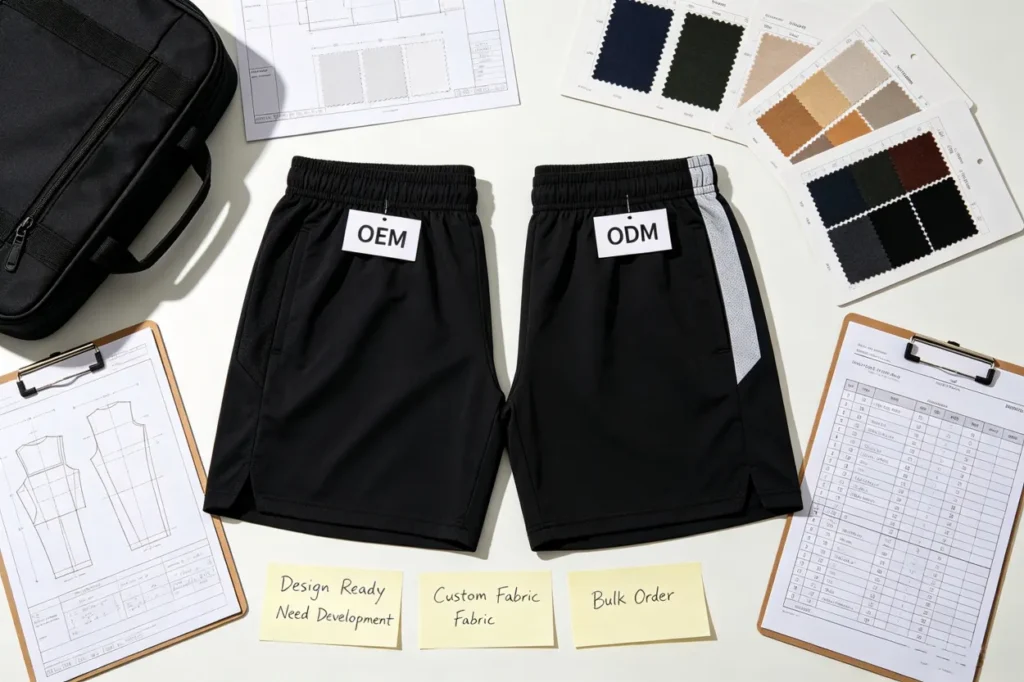
[OEM vs ODM gym shorts manufacturing can feel confusing when your brand has a product idea but not a clear production path. A wrong choice can create repeated samples, vague quotations, and missed launch dates. The better approach is to match the cooperation model with how complete your product information already is.
OEM fits brands that already have mature design files, size specs, fabric requirements, and construction details. ODM fits brands that need factory support to turn a logo, reference photo, market idea, or rough concept into manufacturable gym shorts. Many real projects sit between the two, so product readiness matters more than the label.
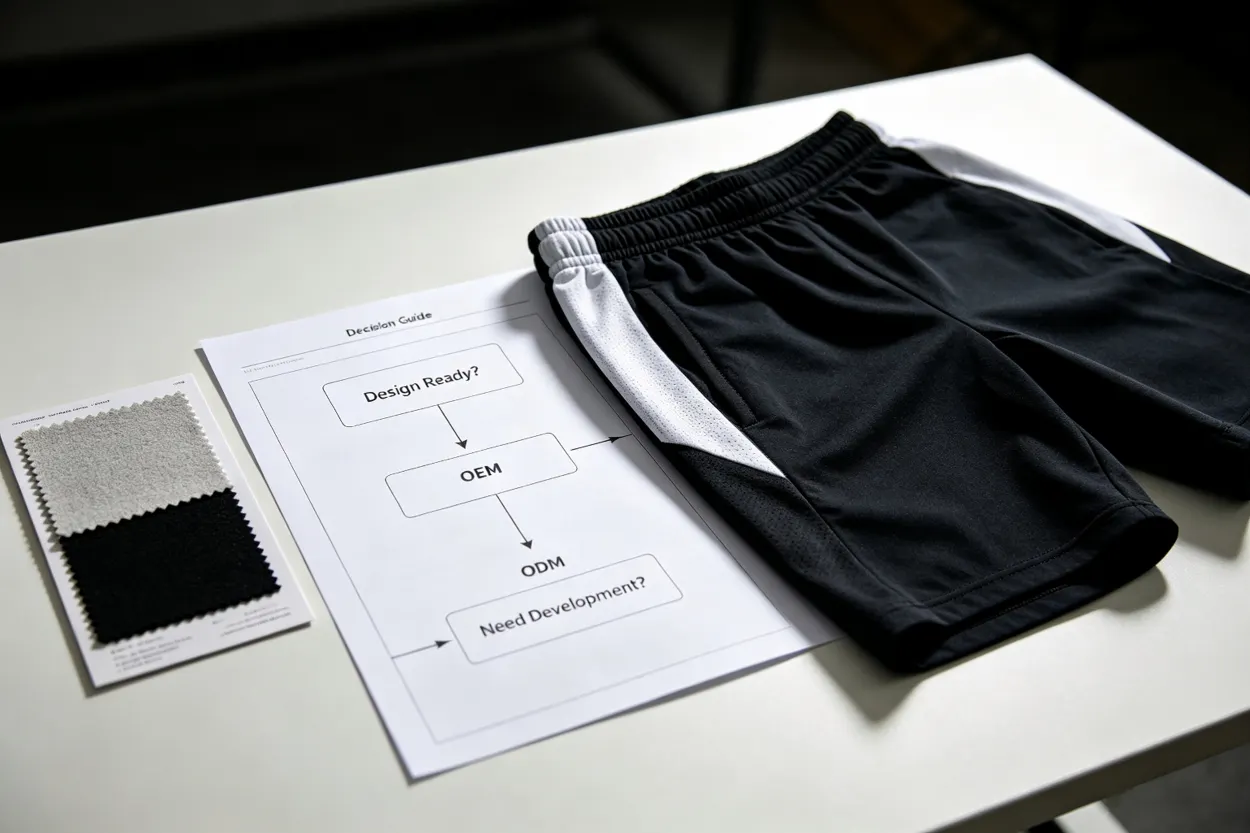
In our customer communication, the first problem is rarely "OEM or ODM?" The real question is usually: How much information is ready for sampling? Once that is clear, the quotation, sample plan, fabric selection, and production schedule become much easier to manage.
What Does OEM vs ODM Gym Shorts Manufacturing Really Mean?
Many buyers use OEM and ODM as simple labels, but that can cause trouble. OEM is not just "custom," and ODM is not just "factory design." If the meaning is too loose, both sides may expect different work before the first sample even starts.
OEM vs ODM gym shorts manufacturing refers to two cooperation models. OEM uses the buyer's existing product specification for production. ODM uses the factory's development support to help shape the product before production. The best model depends on the buyer's design readiness, not on whether one model is better than the other.
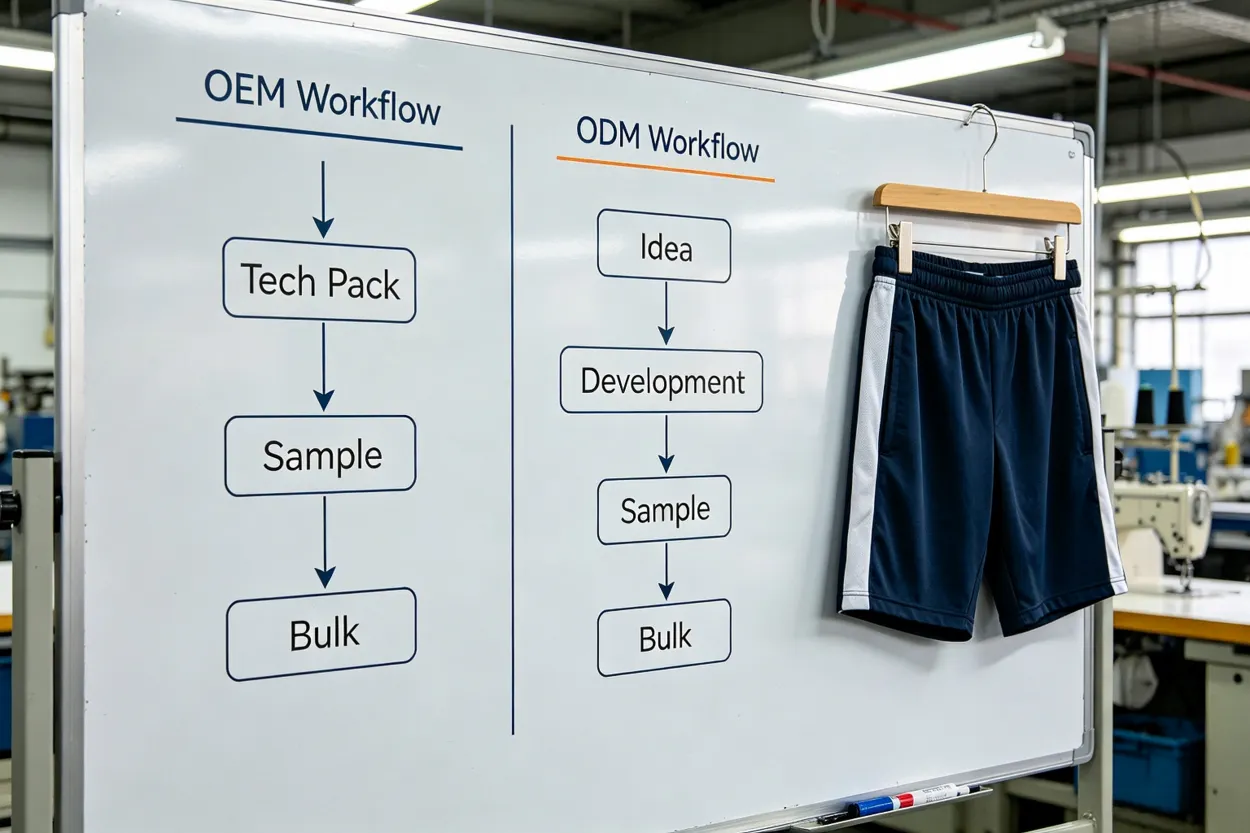
OEM means the buyer leads the product specification
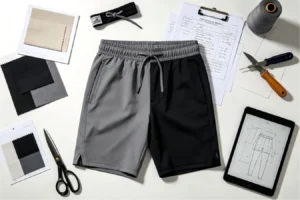
In an OEM gym shorts project, the brand normally provides the key documents and decisions. These may include:
- Design artwork or CAD drawings
- Tech pack with measurements
- Size chart and grading rules
- Fabric composition and GSM target
- Waistband structure
- Liner requirements
- Pocket type and placement
- Logo method, such as heat transfer, embroidery, or screen print
- Stitching details
- Label and packaging requirements
For example, an existing sportswear brand may already sell a training short in Europe and wants to move production to a new supplier. That buyer may send a physical sample, a complete size chart, and detailed fabric information. In that case, the supplier's job is to review manufacturability, confirm material availability, make a sample, and prepare for bulk production.
OEM works well when the buyer already knows what the product should be.
ODM means the factory supports product development
In an ODM gym shorts project, the buyer may only have a direction. The starting point may be:
- A logo
- A reference photo
- A competitor product link
- A target retail price
- A sport category, such as gym, running, or basketball
- A general style idea
- A market positioning, such as budget teamwear or premium fitness apparel
During product development, our factory may help clarify fabric options, waistband structure, pocket design, inseam length, liner choices, and logo placement. The buyer still makes the commercial decisions, but the supplier gives more input before sampling.
ODM works well when the buyer knows the market goal but has not finished the product details.
The gray area is very common
Many gym shorts projects are neither pure OEM nor pure ODM. This is one issue we frequently encounter.
A buyer may send a clear design image but no size chart. Another buyer may have a physical sample but wants to change the fabric stretch, shorten the inseam, add a phone pocket, and adjust the waistband. A new fitness brand may know the style but not know whether the fabric should be polyester-spandex, nylon-spandex, mesh, or woven stretch.
That means the cooperation model may look like this:
| Buyer Readiness | Likely Model | Factory Support Needed |
|---|---|---|
| Complete tech pack and fabric specs | OEM | Sampling and production review |
| Reference sample but missing construction details | OEM + development support | Fabric, sizing, and sewing clarification |
| Logo and reference photo only | ODM | Style development and sample planning |
| Existing product but new supplier | OEM | Product matching and quality review |
| New category expansion | ODM or hybrid | Material and fit recommendations |
This is why a supplier may ask many questions before quoting. Those questions are not delays. They protect the buyer from inaccurate pricing and repeated sample revisions.
If your team wants to review our broader cooperation options, our OEM and ODM service page gives a useful starting point.
When Is OEM vs ODM Gym Shorts Manufacturing Better for a Mature Brand?
A mature brand can lose time if it chooses the wrong model. If the product is already proven, too much redesign may create unnecessary risk. But if the existing documents are incomplete, calling the project "OEM" may still leave major decisions unresolved.
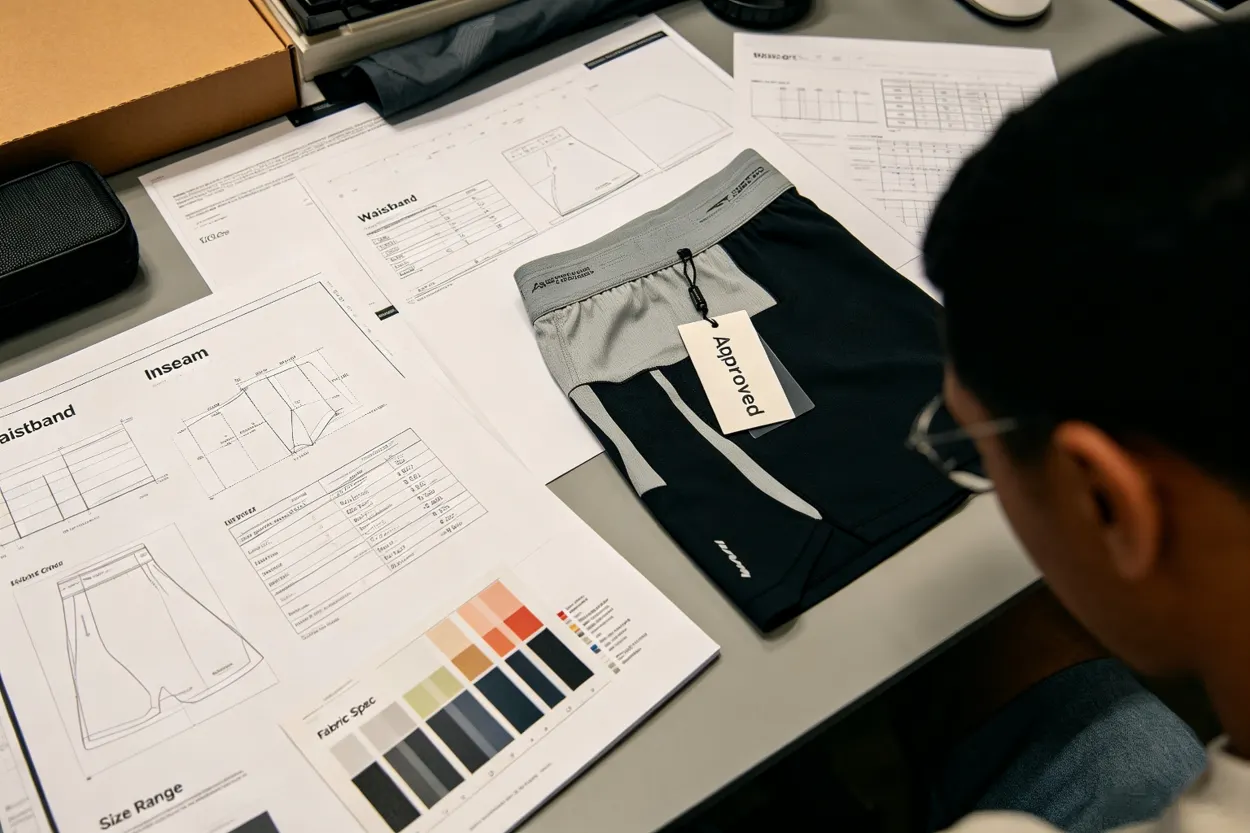
OEM vs ODM gym shorts manufacturing favors OEM when a mature brand already has complete technical documents. If your design files, measurements, fabrics, trims, construction methods, and quality expectations are clear, OEM usually gives better control over consistency, repeat production, and supplier comparison.
A mature OEM inquiry should be specific
Based on our OEM experience, stronger inquiries usually include enough detail for the factory to evaluate cost and sampling feasibility. A mature buyer does not need to have every small issue solved, but the main product architecture should be clear.
A useful OEM package often includes:
-
Tech pack
The tech pack should show the front view, back view, side view, measurement points, tolerances, and construction notes. -
Size chart
The size chart should include the target market. A U.S. gym brand, a European teamwear buyer, and an Asian retail line may need different fit expectations. -
Fabric requirements
The buyer may specify composition, weight, stretch direction, hand feel, colorfastness expectations, and finish. Performance claims should be verified with qualified testing when required by the buyer's market. -
Reference sample
A physical sample is helpful because fabric hand feel, waistband tension, and fit are hard to judge from images alone. -
Branding method
Heat transfer, embroidery, woven patch, rubber patch, and screen print all affect cost, MOQ discussions, and production process. -
Packaging and labeling
Export cartons, polybags, hangtags, barcode labels, and care labels should be discussed early.
Mature brands still have hidden gaps
Even experienced buyers may have missing product information. During sample approval, the missing details often show up in small but important ways.
Common gaps include:
- The fabric code from the previous supplier is unavailable
- The size chart does not include tolerance
- The waistband elastic quality is not specified
- The liner fabric is shown in photos but not defined
- The pocket bag fabric is missing
- The drawcord length and tip style are not listed
- The buyer wants the same fit but has no approved sample
These gaps do not mean the buyer is unprofessional. They are normal when a brand changes suppliers or expands a product line. However, they do affect how the factory should manage the project.
OEM helps with supplier comparison
For mature brands, OEM also makes supplier comparison more reliable. If three factories quote the same product file, the buyer can compare price, lead time, sample quality, communication speed, and production capability more fairly.
However, if each factory receives a different explanation, the comparison becomes weak. One factory may quote a basic polyester fabric. Another may quote a four-way stretch fabric. A third may include a compression liner. The unit prices may look very different, but they are not based on the same product.
A better purchasing approach is to send the same package to each shortlisted supplier:
| Information | Why It Matters |
|---|---|
| Tech pack | Reduces interpretation differences |
| Size chart | Controls fit and grading |
| Fabric target | Makes price comparison fair |
| Quantity range | Helps supplier estimate production planning |
| Color list | Affects fabric dyeing or stock availability |
| Logo details | Affects process and cost |
| Timeline | Helps judge feasibility |
For buyers who already have a gym or running shorts product ready for supplier evaluation, our custom gym and running shorts manufacturing page shows the type of product category we handle most often.
When Is OEM vs ODM Gym Shorts Manufacturing Better for a New Brand?
New brands often move fast. They may have a logo, a launch idea, and a few reference photos. The problem appears when they ask for a firm price before the product is defined. That can create frustration on both sides.
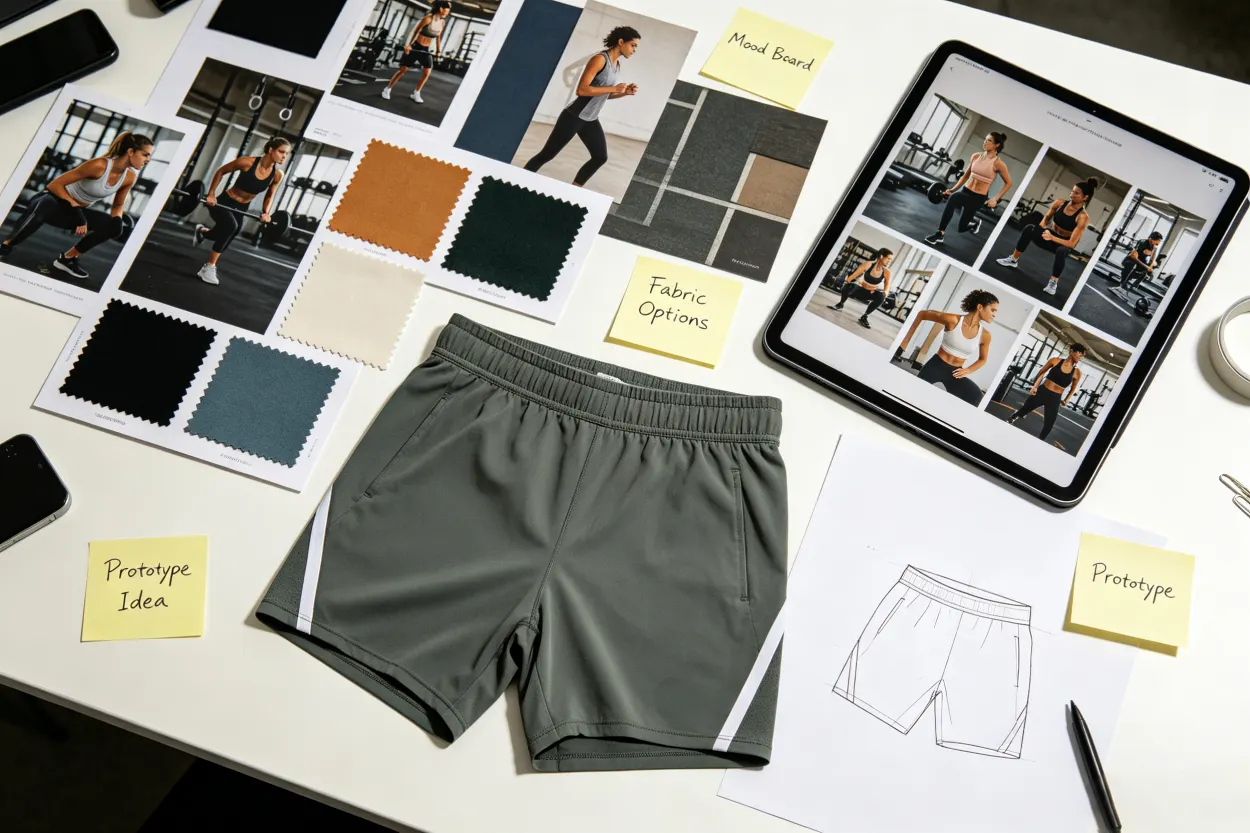
OEM vs ODM gym shorts manufacturing usually favors ODM when a new brand still needs help turning an idea into a manufacturable product. If you do not yet have a tech pack, fabric specification, size chart, or construction plan, ODM support can reduce confusion before sampling begins.
New brand inquiries often start with a reference image
In our factory, a common message looks like this:
"Can you make shorts like this photo with our logo? What is your best price?"
That question is understandable, but the photo alone does not define the product. Two gym shorts can look similar in a picture but use completely different materials and construction.
The factory still needs to confirm:
- Is the fabric woven or knitted?
- Does it need two-way or four-way stretch?
- Is there an inner liner?
- Is the liner compression style or mesh brief style?
- Does the waistband use exposed elastic, enclosed elastic, or elastic plus drawcord?
- Are there side pockets, zipper pockets, or phone pockets?
- What inseam length is needed?
- What size range is planned?
- What order quantity range should the factory estimate around?
Without these answers, the quotation may be too broad or misleading.
ODM helps convert market direction into product decisions
ODM does not mean the factory controls your brand. It means the factory helps organize the product decisions that your brand has not yet finalized.
For example, a new gymwear brand may want men's training shorts for North America. The brand may want a clean design, mid-range retail positioning, and a comfortable fit for workouts. In that case, the development discussion may cover:
| Product Area | Typical ODM Discussion |
|---|---|
| Main fabric | Polyester-spandex knit, nylon-spandex, woven stretch, mesh |
| Fit | Slim athletic fit, regular fit, relaxed team fit |
| Length | 5-inch, 7-inch, or longer inseam direction |
| Waistband | Flat front, gathered elastic, drawcord style |
| Pockets | No pocket, side pocket, zipper pocket, phone pocket |
| Liner | No liner, mesh brief, compression liner |
| Logo | Heat transfer, embroidery, patch |
| Packaging | Basic export packaging or retail-ready packaging |
The buyer still chooses the final direction. The factory helps explain what each choice means for sampling, cost, and production complexity.
New brands should avoid "lowest price first"
One mistake appears often. Some buyers ask for the lowest unit price before confirming quantity, fabric, function, or construction. A low price may look attractive, but it can lead to the wrong sample.
A cheaper quotation may assume:
- Basic fabric
- No liner
- Simple waistband
- No zipper pockets
- One logo only
- Basic packaging
- Large quantity estimate
If the final product later includes premium stretch fabric, compression liner, zipper pockets, custom labels, and multiple colorways, the original price no longer applies. That creates distrust, even though the first quote was based on incomplete information.
A better ODM discussion starts with the target product and expected positioning. Then the factory can suggest a practical sample direction. Once the sample is approved, the factory can prepare a more accurate quotation for bulk production.
For new buyers who want to understand the steps from idea to shipment, our production process overview explains how sampling and bulk order stages are usually organized.
How Does OEM vs ODM Gym Shorts Manufacturing Affect Cost and Timeline?
Cost problems often begin before production. If the product details are unclear, the first quotation may not match the final sample. Then the buyer pays through extra revisions, longer communication, missed selling windows, or wrong material choices.
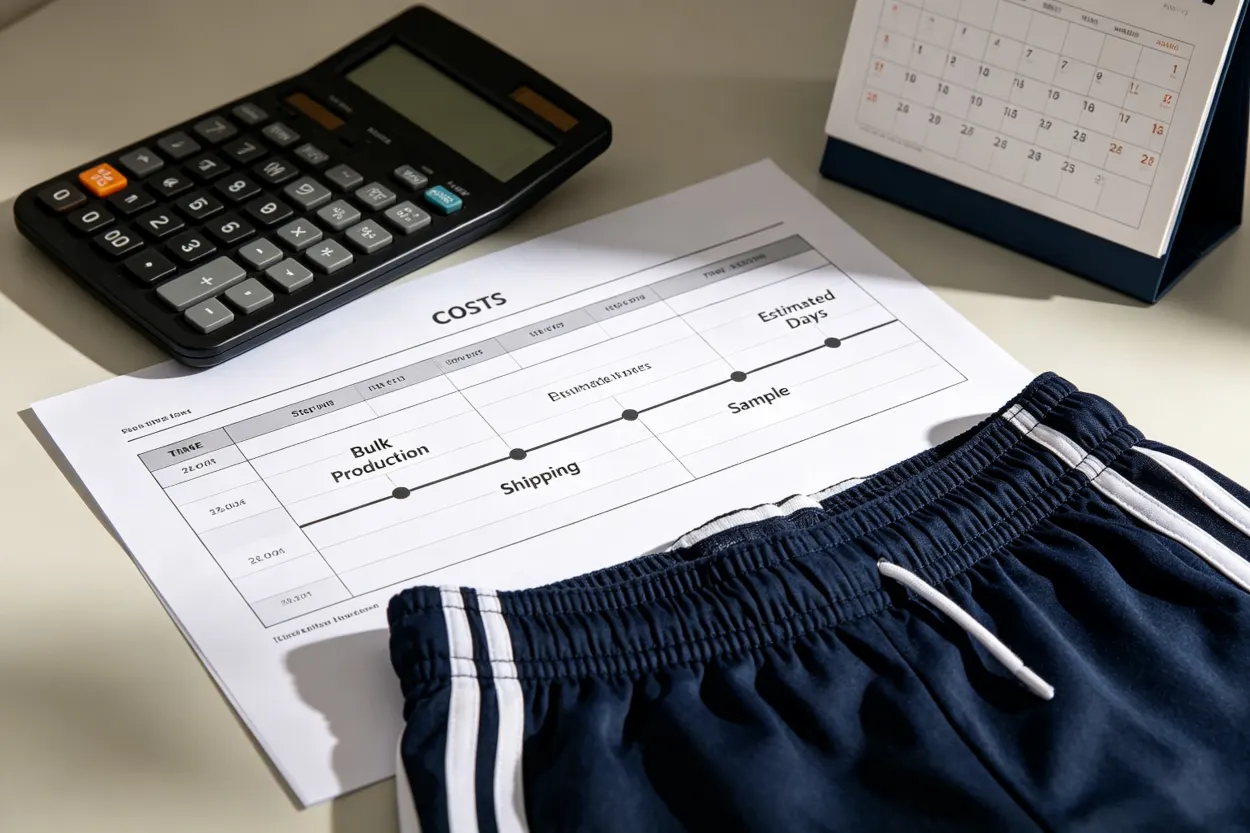
OEM vs ODM gym shorts manufacturing affects cost and timeline through product clarity. OEM can be faster when documents are complete. ODM may take longer before sampling because product details must be developed. In both models, unclear requirements increase total cost more than many buyers expect.
Unit price is only one part of total cost
Many buyers compare suppliers by unit price first. That can be useful only after the product specification is clear. Before that, the unit price is just an estimate based on assumptions.
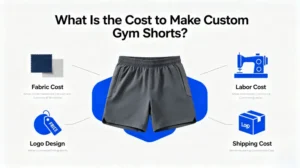
The real cost includes:
- Sample fee or development cost
- Fabric sourcing time
- Pattern adjustment
- Logo mold or printing setup when applicable
- Sample revisions
- Bulk fabric purchase
- Trims and packaging
- Quality control during production
- Shipping method
- Time cost from delayed launch
During product development, a short delay in decision-making can create a longer delay later. For example, if fabric is changed after the first sample, the pattern and fit may need to be checked again. If the waistband structure changes, the sewing process and cost may also change.
Sampling time depends on approval readiness
We use a practical timeline in our communication, but it depends on product confirmation. Once everything is approved for sample production, samples usually take 8–10 working days to produce. Express shipping often takes 5–7 days.
That timeline does not include long decision gaps, missing artwork, fabric changes, or repeated design changes. Those issues can extend the development cycle.
For bulk orders, production often takes 25–30 working days after approval and preparation. Shipping depends on the method. Express services such as FedEx or DHL often take 5–7 days, while air freight may take 10–15 days. Buyers should confirm the final schedule with the supplier based on order details and destination.
OEM can be quicker, but only with complete files
A complete OEM project may move faster because the supplier does not need to help define every detail. The factory can review the tech pack, check fabric availability, make the sample, and compare the result with the buyer's standard.
However, OEM becomes slower when the files are incomplete. A buyer may believe the project is OEM because the design is already finished visually. But if size specs, fabric specs, and sewing details are missing, the project still requires development support.
ODM can reduce wrong decisions early
ODM may take more time before the first sample because the product direction needs to be clarified. But that time is not wasted if it prevents the wrong sample.
For example, a buyer may want a premium gym short with a soft hand feel and good stretch. If the factory immediately makes a basic polyester sample to save time, the buyer may reject it. A better process is to discuss the fabric direction first, even if that adds communication at the beginning.
A practical cost-control method
A buyer can reduce total cost by separating decisions into stages:
-
Confirm product direction
Define use case, target customer, fit, and price positioning. -
Confirm main material direction
Choose fabric type before building the sample. -
Confirm construction
Decide waistband, liner, pockets, inseam, and logo process. -
Approve sample standard
Use the approved sample as the reference for bulk production. -
Confirm bulk details
Finalize quantity, colors, size ratio, labels, packing, and shipping plan.
This staged method reduces guesswork. It also makes supplier quotations easier to compare.
What Information Should You Prepare Before Asking for OEM or ODM?
A weak inquiry creates weak answers. A strong inquiry gives the supplier enough information to guide the next step. The difference is not about being a large brand. The difference is preparation.
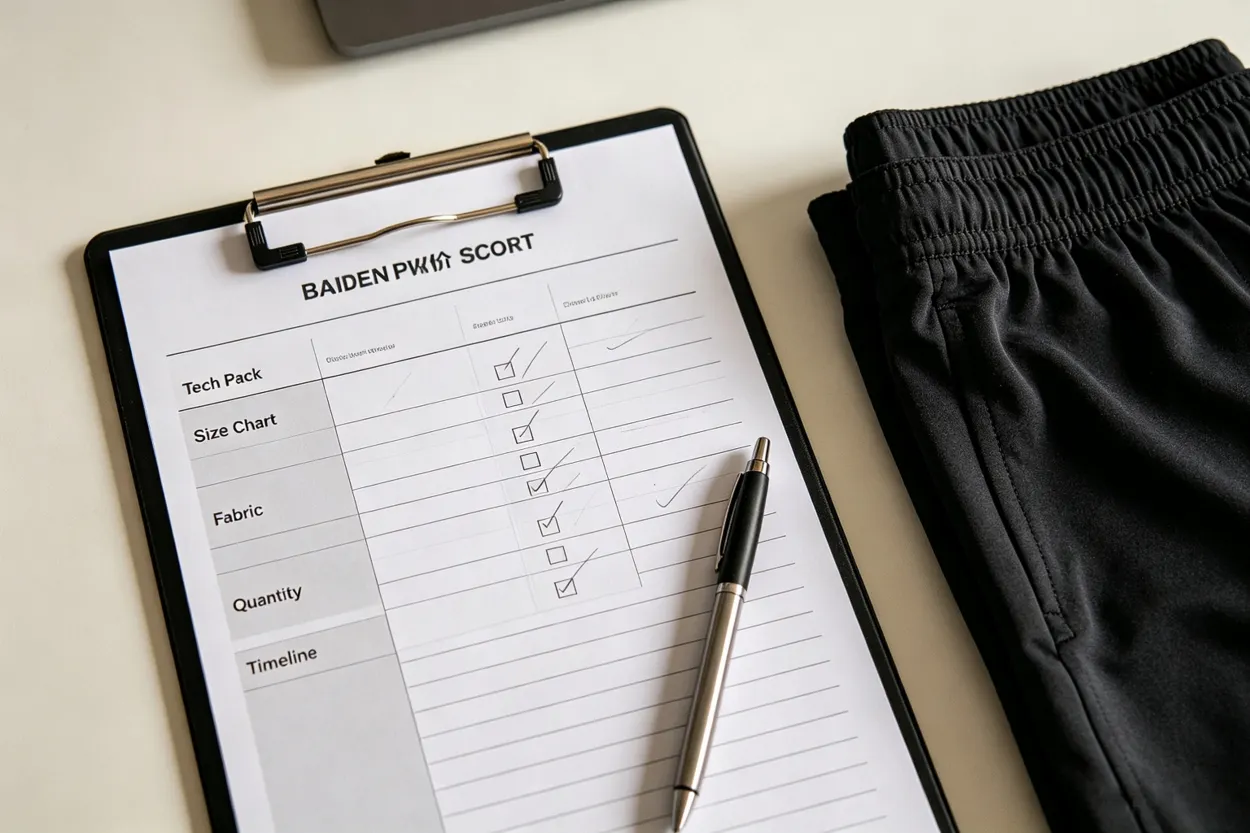
Before choosing OEM or ODM, prepare the information that defines your gym shorts project. The most useful items are design files, reference samples, size charts, fabric goals, function requirements, quantity estimate, color plan, size range, launch timeline, and expected sample revision schedule.
The practical inquiry checklist
Before sending an inquiry, I recommend preparing as many of these items as possible. You do not need every item for an ODM discussion, but each detail helps the factory respond more accurately.
1. Product design information
Send any of the following:
- Tech pack
- Flat sketches
- Reference photos
- Physical sample
- CAD artwork
- Product links for style direction
A photo is useful, but it should not be the only reference if fit and construction matter.
2. Size and fit information
Fit is one of the most common causes of sample revision. Prepare:
- Size chart
- Target market
- Fit type
- Inseam length
- Waist measurement method
- Tolerance requirement
- Reference sample size
If you do not have a size chart, the supplier may provide a suggested starting point, but your brand should approve it carefully.
3. Fabric and function requirements
Gym shorts can use many fabric types. The right choice depends on use case.
Common directions include:
- Lightweight woven stretch for training
- Knit polyester-spandex for comfort
- Mesh for breathability
- Nylon-spandex for a smoother hand feel
- Liner fabric for compression or support
If your market requires specific testing, compliance, or documentation, you should verify those requirements with qualified professionals or certification bodies. A factory can provide available documents for review, but buyers should confirm whether they meet the destination market's rules.
4. Construction details
Clarify the parts that affect production:
| Detail | Options to Confirm |
|---|---|
| Waistband | Elastic, drawcord, flat front, covered elastic |
| Pockets | Side, zipper, back, phone pocket |
| Liner | None, mesh brief, compression liner |
| Hem | Standard fold, binding, split hem |
| Logo | Heat transfer, embroidery, print, patch |
| Labels | Woven label, printed care label, hangtag |
| Packing | Polybag, carton, retail packaging |
These choices affect sampling and bulk cost.
5. Commercial planning details
A supplier also needs the business side of the order:
- Expected order quantity
- Colorways
- Size range
- Size ratio if known
- Target launch date
- Destination country
- Preferred shipping method
- Packaging requirement
- Acceptable sample revision plan
A factory cannot give a meaningful price if the order could be 100 pieces or 10,000 pieces, with unknown colors and unknown construction. A range is better than no number.
A simple decision framework
Use this framework before your next inquiry:
| Your Situation | Better Starting Model |
|---|---|
| You have a complete tech pack and approved sample | OEM |
| You have design drawings but no fabric specs | Hybrid OEM/ODM |
| You have a logo and reference photo only | ODM |
| You want to copy your existing product with a new supplier | OEM |
| You want to launch a new gym shorts line from market research | ODM |
| You know the function but not the construction | ODM |
| You have a sample but want major changes | Hybrid |
This framework does not replace supplier evaluation. It simply helps your team start the conversation in the right direction.
If your project is ready for review, you can send your details through our contact page and include your files, photos, quantity range, and launch timeline.
How Should You Evaluate an OEM or ODM Gym Shorts Supplier?
A supplier may offer both OEM and ODM, but the buyer still needs to evaluate the factory carefully. A good match is not only about price. It is also about communication, sample accuracy, material handling, production follow-up, and export experience.
Evaluate an OEM or ODM gym shorts supplier by checking product category experience, sample process, communication quality, material options, quality control steps, export support, and willingness to clarify details before quoting. A supplier that asks precise questions early may help prevent bigger problems later.

Look for category experience
Gym shorts are not all the same. A factory that makes only casual woven shorts may not understand training shorts, running shorts, basketball shorts, or boxing shorts. The sewing methods, fabrics, liners, and fit expectations can differ.
In our factory, the repeated questions from buyers usually focus on:
- Stretch and comfort
- Waistband stability
- Pocket function
- Logo durability
- Fit consistency
- Sample revision speed
- Bulk order quality control
- Export packing
A supplier with category experience should be able to discuss these points in practical language.
Review the sample process
The sample process shows how the supplier works. Buyers should ask:
- What information is needed before sampling?
- How are fabric and trim choices confirmed?
- Can the supplier follow a tech pack?
- How are sample comments recorded?
- How many changes are being requested after each sample?
- What happens if fabric changes after the first sample?
Once everything is approved, our sample production usually takes 8–10 working days, with express shipping often taking 5–7 days. However, the real development schedule depends on the buyer's decision speed and the complexity of the product.
Ask how quality is controlled during production
For bulk production, buyers should understand the supplier's quality control steps. The factory should be able to explain how it checks:
- Fabric before cutting
- Color and material consistency
- Cutting accuracy
- Sewing workmanship
- Waistband and drawcord details
- Logo placement
- Measurement tolerance
- Packing and carton marks
A buyer should not rely only on a final photo. For higher-risk orders, third-party inspection may be useful. If certifications or test reports are required, buyers should verify the documents and confirm that they apply to the exact fabric, trim, or production batch when necessary.
Communication matters more than buyers expect
One of the strongest signs of a suitable supplier is clear communication. If a factory gives a quick price without asking about fabric, size range, quantity, or logo method, the quote may be based on hidden assumptions.
Good supplier communication often includes:
- Clear questions before quotation
- Practical explanation of fabric options
- Written confirmation of sample details
- Photos or videos during development when useful
- Clear comments after sample review
- Updated production progress during bulk orders
- Export document coordination
During bulk production, small misunderstandings can become costly. A missing label, wrong drawcord color, or unclear packing instruction may delay shipment. Clear communication reduces those risks.
Compare suppliers on the same basis
A useful supplier comparison should include more than unit price.
| Evaluation Point | Why It Matters |
|---|---|
| Product category experience | Reduces development mistakes |
| Sample accuracy | Shows technical understanding |
| Communication speed | Helps keep timeline moving |
| Material options | Affects product positioning |
| QC process | Supports bulk consistency |
| Export experience | Reduces shipping and document issues |
| Transparency | Builds long-term cooperation |
The best supplier for your brand is not always the cheapest. It is the supplier that fits your product readiness, quality expectation, order scale, and communication style.
Frequently Asked Questions
Is OEM cheaper than ODM for gym shorts?
OEM can be cheaper when your tech pack, fabric, sizing, and construction details are complete because the factory spends less time on development. ODM may include more product planning and sampling discussion. However, the final cost depends on fabric, quantity, trims, logo method, packaging, and revision needs.
Can I start with ODM and later switch to OEM?
Yes. Many brands begin with ODM support for the first product and later treat repeat orders as OEM after the design, size chart, fabric, and construction details are approved. For repeat production, the approved sample and confirmed specifications become the key production reference.
What should I send to get an accurate gym shorts quotation?
You should send design files or reference photos, size chart, fabric preference, logo method, quantity range, colors, size range, packaging needs, and launch timeline. If you have a physical sample or tech pack, send that too. More complete information helps the supplier quote more accurately.
Why does a factory ask many questions before quoting?
A factory asks questions because gym shorts with similar photos can have different fabrics, liners, pockets, waistbands, and sewing details. These differences affect cost and production time. Clarifying details early helps prevent inaccurate quotations, wrong samples, and repeated revisions.
How long does gym shorts sampling usually take?
Once all sample details are approved, sample production usually takes 8–10 working days. Express shipping often takes 5–7 days. The full development timeline can be longer if fabric, sizing, artwork, or construction details change during the process.
Conclusion
OEM vs ODM gym shorts manufacturing is not a choice between low-end and high-end production. It is a readiness decision. OEM fits brands with complete product files and clear standards. ODM fits brands that still need help turning an idea into a manufacturable product. Many projects fall between the two, so clear communication matters. If you are preparing a new gym shorts order, send your tech pack, reference photos, size range, fabric goals, quantity estimate, and launch timeline. We can review your project and help you decide whether OEM, ODM, or a hybrid workflow makes the most sense.